

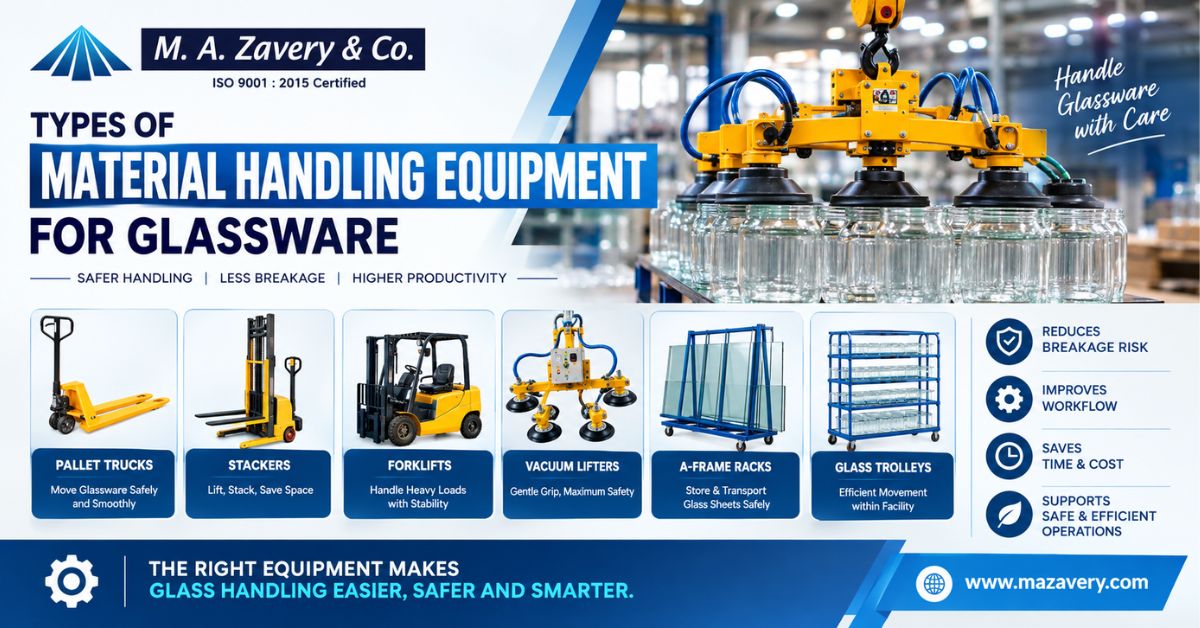
Glass shatters. That one fact drives almost every decision a glassmaker, glazier, or logistics team makes about how to move it. Dent in dropped steel coil. A dropped glass sheet shatters, and so does the cost of the material, the labour that went into producing it, and sometimes the safety of anyone nearby.
That’s why the material handling equipment for glassware is different from that in most other industries. This guide covers the major classes of equipment used to handle glass safely, from the handling of raw sheets in a factory to the handling of finished product in a warehouse or on a construction site.
Why Glassware Needs Specialised Material Handling Equipment
Material handling equipment Glass has some problems that other materials don’t. It has very little flex, so a spot of concentrated pressure can turn into a crack. Once you get into architectural or automotive glass sizes, it’s heavy for its surface area, and large sheets flex under their own weight if not supported properly. Once it breaks, there is no option to repair it, only replace it and clean up.
Most glass handling equipment is designed with three objectives in mind: to distribute the load evenly over the surface, to remove any metal-to-glass contact points, and to keep the glass stable during any lateral or vertical movement. All categories solve for at least one of these.
Vacuum Lifters
Vacuum lifters are the most familiar piece of glass handling equipment on a factory floor or a glazing job site. They have suction cups or vacuum pads that connect to a pump. The pump creates a seal against the flat surface of a sheet of glass and allows the glass to be lifted without clamping or gripping the edges.
There are several different types of Hoover lifters. Manual, hand-pump units are suitable for small glass panes and light-duty jobs. Battery- or compressed air-powered units manage larger sheets and higher-volume production runs, often with a built-in vacuum reserve tank so the load remains secure even if the pump loses power mid-lift. Many units also tilt or rotate the sheet of glass. This allows an operator to move a pane from a flat position to a vertical position for installation without ever directly touching the surface of the glass.
Glass Racks and A-Frames
After glass sheets are cut or formed, they need a place to sit that protects them and keeps them upright until the next step in handling. Glass racks and A-frames do the trick. An A-frame is just an angled frame that allows sheets to be positioned at a slight angle so that they sit against padded rails rather than flat, reducing the chances of pressure marks or breakage from sheets stacking directly on top of each other.
Storage or shipping racks normally have rubber or felt padding at all contact points, since a tiny bit of grit between two panes of glass can scratch or crack the surface under load. Mobile A-frames on caster wheels allow operators to move full glass racks across a shop floor without ever having to lift a single sheet.
Conveyor Systems
In high-volume production, conveyor systems move sheets through cutting, tempering, and coating stages with no manual handling at each stage. Roller conveyors support the entire width of the glass, evenly distributing the load and reducing the flex that causes stress cracks in large sheets. Where a gentler ride is required, such as through washing or inspection stations, soft, non-abrasive belt conveyors are common.
Automated conveyor lines and robotic transfer arms are becoming more common in the larger glass manufacturing plants because they reduce the number of manual touches a sheet receives from the furnace to the finished product.
Glass Handling Attachments for Forklifts
Regular forks on forklifts are not meant to handle glass. That changes with a glass-specific attachment. It provides a vertical or near-vertical frame with padded contact points that allows a forklift to carry a rack or crate of glass sheets the same way it would a standard pallet. Boom attachments reach out from a forklift to load long sheets onto trucks or racks at height, and fork-mounted glass clamps grip crates from the side, rather than from underneath (which is the usual approach), in cases where the crate itself isn’t rigid enough to support weight from the forks alone.
Suction Cup Hand Tools
Some glass-handling work doesn’t need a full Hoover lifter. For small panes, mirrors, or one-off installation jobs, handheld suction cups allow a single worker to get a secure grip on a smooth glass surface without touching the edges, where chips and cracks are most likely to start. For dual and multi-cup use, handles spread the load over more contact points, which is important as the size and weight of the pane increase.
Overhead Cranes, Hoists, and Rigging
When glass is no longer in the form of panes or panels, but rather in large architectural units, curtain wall sections or heavy insulated glass units, it is no longer practical to lift it by hand or forklift. Overhead cranes, chain hoists, and rigging equipment can be found there.
A properly rated hoist on an overhead crane can lift a large glass load vertically, and then a trolley can move it horizontally along a beam to a staging area, truck bay, or installation point. The rigging between the hoist and load is just as important as the hoist. Wire rope slings and chain slings shall be rated correctly for the load. If a glass crate or frame is attached to a hoist hook using lifting points or shackles, those shall have a documented working load limit.
This is where a general industrial supplier becomes relevant to a glass operation, even if that supplier doesn’t make glass-specific tools. Since 1983, M.A.Zavery & Co. has supplied hoists, wire rope, chain and rigging accessories throughout India, with brands such as Elephant, Safelift, Yoke and Bridon Bekaert. That’s the kind of equipment a glass manufacturing plant or glazing contractor depends on when moving raw material, finished crates, or heavy glass units through a facility: chain hoists and lever hoists for vertical lifts, plain or geared trolleys to move loads along a beam, wire rope or chain slings to rig the load safely to the hoist.
How to Choose the Right Equipment for Your Glass Handling Job
Here’s a simple way to narrow down what you really need.
- Find out the glass format. Vacuum lifters and racks are needed for flat sheets and panes. More commonly, framed units, crates, or insulated glass units will need overhead lifting instead.
- Check weight and dimensions. Hand tools are suitable for small panes. Large architectural sheets or heavy insulated units require powered hoover lifters or crane-based lifting.
- Path handling. A short move across a shop floor might only require a mobile A-frame. A hoist and trolley combination is what you need for a vertical lift from ground level to an upper floor.
- Confirm your ability to rig. Any sling, shackle or lifting point used with a crane or hoist must have a rated capacity that will exceed the actual load with a margin of safety.
- Surface protection. All points of contact between the glass and the equipment should be rubberised, padded or otherwise non-abrasive.
- Ensure power availability. All compressed-air, battery-powered hoists and electric chain hoists require a power source at the point of use, so make sure you have this available before you commit to a particular unit.
Safety Considerations When Handling Glass
In most cases, glass handling problems can be traced to one of two causes: equipment that is not rated for the actual load or a contact point that concentrates the pressure instead of distributing it. There are some habits that cut both risks.
- Before every lift, check the hoover pads and seals. A pad that is worn or cracked will lose suction much quicker than you think.
- Never overload a hoist, sling or lifting attachment, even if a load “looks” light enough.
- When possible, store and transport glass sheets in a vertical or near-vertical position, as flat stacking increases the possibility of pressure cracks.
- Train operators on the specific equipment they will be using. A hoover lifter and an overhead hoist require different instincts to operate, and mixing them creates unnecessary risk.
- All cranes, hoists, or rigging gear used in the process must comply with the applicable lifting equipment standards, including the inspection and maintenance schedules specified by bodies such as the American Society of Mechanical Engineers under its ASME B30 series of standards.
Wrapping Up
Safe glass movement is determined by the equipment used to suit the format, weight, and the handling path of the load. Most of the flat sheet handling inside a glass plant is done by vacuum lifters, racks and conveyors. Once loads get beyond what a forklift or hand tool can do, overhead hoists, trolleys and rated rigging take over. If your glass handling process includes overhead lifting, chain hoists, or wire rope rigging, M.A. Zavery can help you source the right rated equipment for that part of the job.
FAQs
What is the best equipment for lifting large glass panels?
Most large flat panels are handled by powered hoover lifters, as these distribute the suction over the surface and do not touch the edges. For units that are too heavy for a hoover lifter to handle, a properly rigged overhead hoist is used for framed or crated units.
Can a forklift move glass safely?
Yes, if properly attached. A typical fork setup can cause a load of glass to tip or crush, but a boom or clamp attachment designed for glass enables a forklift to carry racks or crates much as it would palletised goods.
Why do glass racks use padded rails instead of flat shelves?
The rails are angled and padded so the glass sheets can lean at a slight tilt rather than rest flat, reducing the pressure points that cause cracks when sheets stack directly against each other.
Do overhead hoists work for heavy glass units?
Yeah. Heavy architectural glass, insulated glass units and curtain wall panels may be too much for a forklift or hoover lifter to handle safely, so an overhead crane or chain hoist with rated slings and rigging will be the practical choice.
How often should glass handling equipment be inspected?
Vacuum lifters shall be checked for seal and suction prior to each shift use. Hoists, slings, and rigging equipment must be on a documented inspection schedule based on the applicable standard and manufacturer’s recommendations, usually at predetermined times throughout the year.