

Types of Material Handling Equipment in Construction
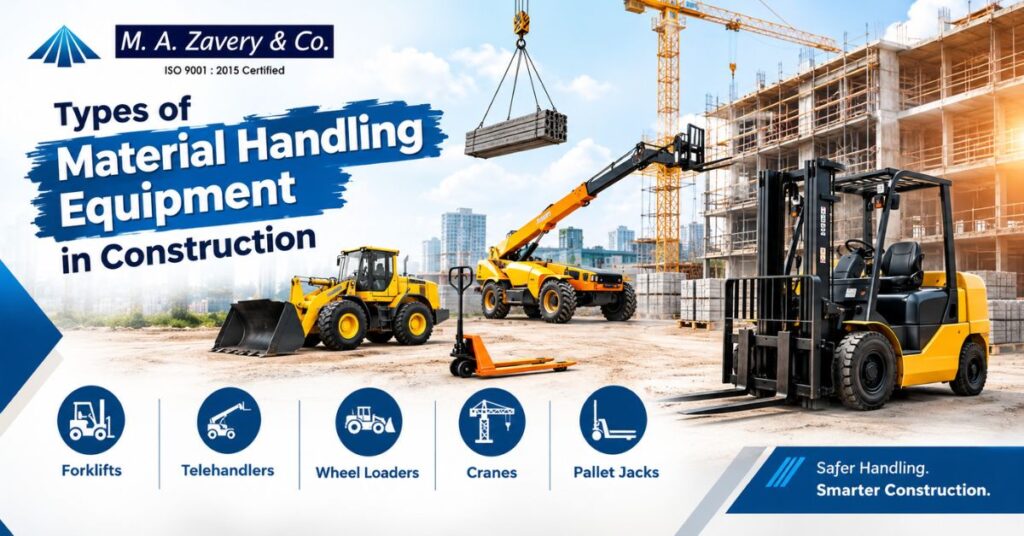
Movement feeds every construction site. Steel beams must go up. We have to carry the cement bags from the truck to the mixing area. Pipes, panels, and machinery all need to move from point A to B without anyone getting hurt. That’s what the cranes, hoists and rigging gear are for – that’s what they’re built for. If you’ve ever wondered what separates a site that runs on time and one that’s always waiting around for a crane or a broken hoist, it all comes down to choosing the right gear for the job. This guide covers the main types of material handling equipment used in construction, how they work, and how to choose between them. What Is Material Handling Equipment? Material handling equipment means any mechanical tool or machine used to move, lift, position, or store materials in the course of a project. That includes everything from a hand-operated chain hoist to a tower crane lifting concrete panels forty floors up on a construction site. Industry commonly categorises this gear into a few broad classifications: transport tools, which move loads from one place to another; positioning tools, used to place or angle a load at a single location; and storage equipment. But on a job site, the bulk of what you will actually see in daily use will be cranes, hoists, and powered trucks. Why the Right Lifting and Handling Gear Matters on a Construction Site The right equipment choices have three direct impacts: safety, timeline, and cost. This is why it matters more than you might initially think. A crew that lifts by hand what should be done mechanically is slower and far more prone to injury. Tools that are undersized for the job will wear faster and cause stress on the whole schedule. And if any equipment isn’t properly inspected or rated, it’s a liability the moment something fails mid-lift. The U.S. Occupational Safety and Health Administration (OSHA) has specific rules about the inspection, rating, and use of this gear at construction sites, from rigging slings to powered industrial trucks. Understanding the types of equipment listed below is the first step in meeting those standards and operating a safer site. Types of Material Handling Equipment in Construction The right equipment choices have three direct impacts: safety, timeline, and cost. 1. Cranes Cranes are used to lift and move heavy loads vertically and horizontally on a site. Typical types of construction projects are: Tower cranes for high-rise construction where materials must be lifted to great heights. Mobile cranes that can move from place to place on a site. Crawler cranes that operate on tracks and carry very heavy loads on uneven terrain. ASME B30.5 applies to crawler, locomotive, and wheel-mounted cranes powered by internal combustion engines or electric motors and is a standard reference point throughout the building and construction industry. 2. Hoists Hoist: a device for raising and lowering loads by means of a drum, wheel or lift-wheel over which a chain or wire rope is wound. The hoist is often the workhorse for vertical lifting on smaller sites and in the fabrication yard when a full crane is not practical. Types of Hoists: There are a few main types of hoists: Hand-operated manual chain hoists for light loads. Electric wire rope hoists – for repeated, heavier lifting. Air (pneumatic) hoists, often employed in areas where sparks from electricity are a hazard. ASME has a performance standard for electric wire rope hoists used in freely suspended lifting service. If your team regularly utilises electric or manual hoists, M.A.Zavery provides a range of hoisting equipment, including manual and electric models, designed for repeated use at sites. 3. Winches Winches don’t lift straight up; they pull. They are used for dragging loads horizontally, tensioning cables, or assisting in positioning heavy equipment that cannot be lifted directly. Manual winches are fine for lighter pulls that aren’t done often. Electric winches are used when you need to pull something repeatedly or very hard, and stainless steel versions last longer in corrosive or outdoor environments where standard steel would rust out faster. 4. Rigging Equipment The rigging gear connects the load to the lifting machine. This group contains slings, shackles, hooks, master links, and chain fittings. Because it is the part of a lift most likely to fail if something is worn, damaged, or mismatched to the load, OSHA tightly regulates this equipment. OSHA requires slings to be inspected before each use and removed from service as soon as damage is detected. This includes chain slings, wire sling fittings, and master links. These are rated by the manufacturer for a specific working load limit, which should never be exceeded. 5. Wire Rope Wire rope is used almost everywhere on a site – in crane systems, hoists, winches and rigging assemblies. It’s steel wires, twisted together, made into strands, then laid around a core. “The wire rope selection depends on the load, the environment and the frequency of use of the rope. A dedicated ASME volume now governs all the equipment types that use it for wire rope selection, testing and replacement. Typically, sites that regularly use wire rope – whether in cranes, hoists or rigging applications – will work with a supplier who can match rope grade to the specific lifting application, rather than purchase off-the-shelf generic stock. 6. Powered Industrial Trucks Forklifts, telehandlers and other similar powered trucks are used for the movement of palletised or bulky materials around a site. OSHA mandates that these types of machines conform to specific design and operation standards, and the operator must be properly trained before operating one. 7. Conveyors Conveyors transport bulk or unit loads along a fixed path. They are useful for moving the same type of material repeatedly between two set points, such as aggregate, gravel, or packaged goods. They aren’t as flexible as cranes or trucks, but they are much faster for repetitive movement of high volumes. 8. Trolleys and Stackers Hand stackers, electric stackers, and drum trolleys are