

Chain Hoist Vs Wire Rope Hoist: Which One Do You Need?
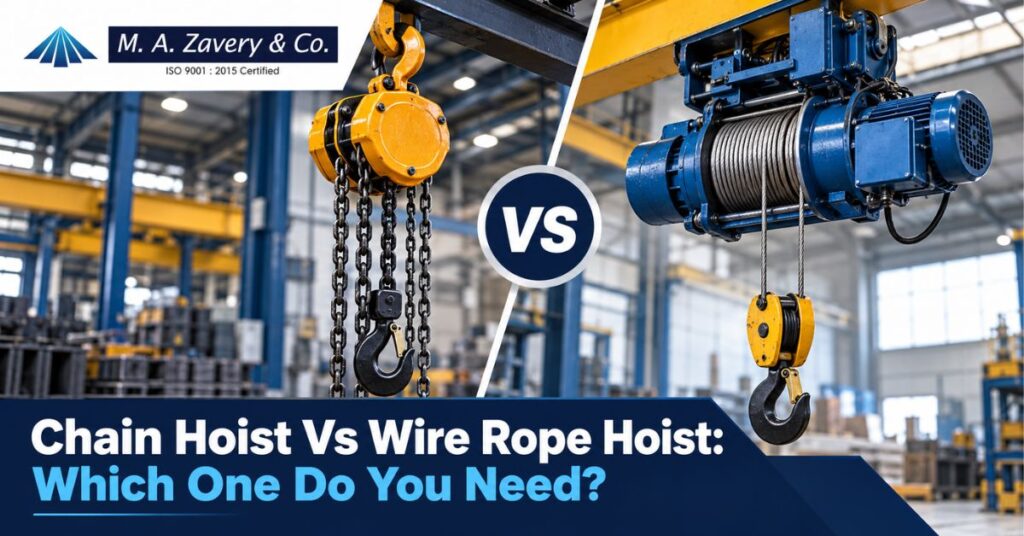
The wrong hoist will cost you slow lifts, premature wear, and a unit that will not fit under your roof beam. Pick the right one, and you forget it’s there, which is exactly what you want. Let’s parse it out. Quick answer: Wire rope hoists generally handle heavier loads at higher speeds, while chain hoists generally require less headroom. Choose a chain hoist for lighter loads, low ceilings, occasional lifts, and simple maintenance. Select a wire rope hoist for heavy loads, long lifts, faster travel, and continuous duty. And this is why. What Is a Chain Hoist? A chain hoist lifts with a load chain running through a pocket wheel rather than winding on a drum. The chain falls into a chain container and passes through sprockets. You will come across four common variations: Hand chain hoists (chain blocks): You pull a hand chain to raise. For this group, M.A.Zavery has the Elephant C21 Series manual hoist and the Elephant H-100 Series chain block. Lever hoists: A short-handle ratchet moves the load up or down. One of the models listed is the Elephant YA Series Lever Hoist. Electric chain hoists: The motor does the work. The site shows a Beta Series electric chain hoist, single-phase Stahl ST, and STD dual-chain hoists. Air chain hoists: Use compressed air for the lift where electric motors are not suitable. Where Chain Hoists Work Best Chain hoists are perfect for workshops, maintenance bays, small fabrication lines, and warehouses. They are popular because they take little maintenance and can be less expensive than a wire rope system. Chain can also beat wire rope. The compromise is speed. Restricted lifting speed. The slower lifting has its silver lining. “When you put a delicate part, a die, or a machined casting, you get fine control.” What Is a Wire Rope Hoist? A wire rope hoist winds a steel rope around a grooved drum. As the rope winds, it follows a spiral groove which holds it in an even layer. The neat coil gives a smoother ride and less load swing. Capacity is high. One Indian manufacturer offers electric wire rope hoists ranging from 1 to 50 tonnes, intended for continuous-duty crane work. Stahl SH and SH Ex wire rope hoists. Bridon wire rope grades, including Dyform and Tiger Blue, are available for rope replacement and rigging on the M.A. Zavery site. Where Wire Rope Hoists Work Best Wire rope hoists are a must at production plants, steel yards, power stations, and any site that lifts all day long. They lift faster and higher than chain units and may be rated for severe duty classes. There are two downsides. The drum is bulkier than a chain mechanism, and in some conditions rope can wear earlier than a chain. Chain Hoist vs Wire Rope Hoist: Side-by-Side Comparison This table shows the main differences at a glance. Use it as a first filter and then look up the real ratings of any model you are shortlisting. Factor Chain Hoist Wire Rope Hoist Load range Light to medium Medium to very heavy Lifting speed Slower, easier to control Faster, smoother Headroom needed Usually less Usually more (drums take space) Lift height Moderate Higher Duty cycle Intermittent work Continuous or heavy work Upkeep Simpler, lower cost Regular rope inspection Purchase price Often lower Often higher “Above about 10 tonnes, or with heavy-duty cycles, wire rope is ahead,” says one manufacturer. Compact and lighter, electric chain hoists are ideal for intermittent work. 10 tonnes is a rule of thumb, not a hard line. Manufacturers have their own ratings for their models. How to Choose the Right Hoist: 6 Steps “Write down your heaviest load, not your average load. No. of lifts/hr & run time per shift. With the hook in the fully raised position, measure between the hook and the beam or trolley. Decide how fast you want to lift and how fine the control is. Note the environment: dust, dampness, heat, corrosive fumes, or explosive atmospheres. Who will inspect the hoist and how often Now, let’s recap the steps that most people have trouble with. Match the Load and Duty Cycle Begin with the heaviest load, then add room for growth. “We have plants that we buy for today’s job and grow out of the hoist in two years. Weight is as important as duty cycle. The duty classes for hoists are based on factors including the lifting application, maximum run time, and maximum number of starts. A 3-tonne hoist that runs 40 lifts an hour wears very differently than a 3-tonne hoist that runs four. If your hoist runs all the time, wire rope is the way to go. A chain unit is usually sufficient if it needs lifting a few times a day. Check Headroom and Lift Height Headroom is the distance from the top of the hook to the underside of your support beam. Many low-ceilinged workshops can’t accommodate a standard wire rope hoist. Chain hoists generally require less headroom, so they work with lower ceilings. You will find designs with low-headroom wire rope, but you should compare the dimension drawings before you buy. Long lifts are the opposite way around. Good for high lift heights as rope winds onto a drum. Weight Speed and Control Fast lifting means time savings. Hundreds of loads per week. A slow, steady lift protects delicate cargo. Electric models give you choices. On the M.A.Zavery site, they have a single-phase variable speed Alpha Series with a plain trolley. This allows operators to creep up to a load and then speed up once it clears. Consider the Environment With dust, moisture and chemical vapour, the answer is different. For potentially explosive atmospheres, the Yalelift 360 ATEX hand chain hoist is listed on the site. But air-powered options are another path where electric sparks are a concern. Tiger has pneumatic air hoists, such as the TAH52 for 5-20 tonnes and the TAH250 for 25-60 tonnes. Plan Upkeep and Inspection Chain hoists are the easiest
Manual Hoist vs Electric Hoist: How to Choose the Right One
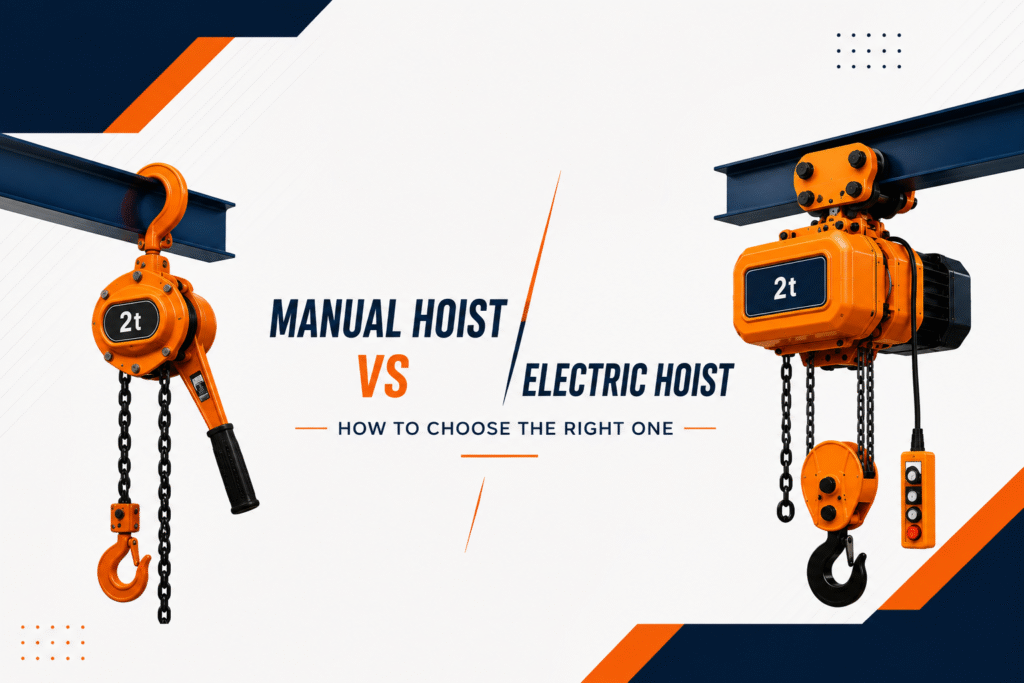
Every lifting job sooner or later comes down to the same question: hand power or motor power? The choice of a manual hoist versus an electric hoist will impact your budget, the speed of your lift, and how often the equipment is used on the floor. Pick the wrong one, and you either overpay for power you rarely use, or you have a hoist that can’t keep pace with your work. This guide describes how each type works, where each one works best, and what to look for before you order. What Is a Manual Hoist? A manual hoist is operated by a man. With a pull on a hand chain or a pump of a lever, gears inside the hoist body multiply your force to lift the load. There are two common forms: Hand chain hoists: a looped chain that you pull, best for straight vertical lifts Lever hoists: useful for lifting, pulling and tensioning at any angle, including sideways or upside down, operated by moving a hand lever back and forth Manual hoists are available with capacities from a few hundred kg to several tonnes from brands such as Elephant (C21 and H100 series chain hoists, YA and Y2 series lever hoists) and Safelift (ratchet lever hoists), so capacity is rarely a limiting factor. The limiting factors for a manual hoist are speed and operator fatigue on repeat lifts. What Is an Electric Hoist? An electric hoist is powered by a motor and is operated with a pendant, push button, or remote. You get a uniform lift speed. You get no operator fatigue. You can lift heavier loads without additional manpower. If you need electric chain hoists for lighter, more frequent lifts in single-phase applications, or for heavier industrial duty in three-phase applications, you can choose from brands such as Elephant (Alpha, Beta, SA, FA/FB and DA/DB series), Yale (CPEF series) and STAHL. Most are equipped with a trolley system, which means the load moves along a beam as well as up and down, making a simple hoist part of a complete material handling system. Manual Hoist vs Electric Hoist: Key Differences Here is a side-by-side comparison of how the two stack up on the points that matter most in making a buying decision. 1. Speed and Output A manual hoist will lift as fast as the operator can pull on the chain or work the lever. Regardless of who is running an electric hoist, it hoists at a constant, steady speed. An electric hoist saves real labour hours over a shift if your team runs the same lift dozens of times a day. 2. Power Supply Manual hoists do not need any electricity at all. This makes them the only realistic choice for remote sites, outdoor jobs where there is no power point, or hazardous areas where powered equipment adds risk. Electric hoists need a stable power supply, either single or three-phase, so you should think about the wiring and load capacity of the site before you buy one. 3. Cost Manual hoists are cheaper to purchase and require less maintenance, as there is no motor, gearbox or control panel to service. Electric hoists are more expensive to buy and install but pay for themselves in labour savings on high-frequency jobs. 4. Load Capacity and Duty Cycle These types are available in a wide range of capacities, from a few hundred kilograms to well over 10 tonnes on heavy-duty electric models. The real difference is the duty cycle. A manual hoist is suitable for occasional or maintenance lifts. Electric hoists are best for continuous or high-frequency lifting where the motor is designed to run repeatedly without overheating. 5. Portability Manual hoists are lighter and easier to move from job to job or workstation. Electric hoists are usually attached to a beam, monorail, or crane system, so they are meant for a permanent lifting point, not a hoist you move around from place to place. Which One Is Right for Your Application? Which One Fits Your Application? How many times will the hoist cycle each day? Many lifts are better. Electric prefers dozens of repeat lifts. Is there power at the lift point? Without a power source, your only real option is the manual. How much does the load weigh, and how far does it move? Heavier, longer travel work generally works better with an electric hoist and trolley. Who runs it and for how long? Pulling it manually can easily lead to a lot of physical strain over a full shift. What is your budget for installation and maintenance? Manual hoists are easier and cheaper to maintain over time, while electric hoists need periodic checks of the motor, brake and control. It’s normal if your answers point in different directions for different parts of your business. Many facilities use both: manual hoists for maintenance bays and occasional lifts, and electric hoists for the production line or high-traffic lifting points. Maintenance Needs for Each Type Manual hoists have no electrical system that can fail but require regular scheduled chain inspection, brake checks, and lubrication. Electric hoists add motor windings, brake discs, limit switches, and control wiring to the list of things to check, so maintenance takes a little longer, but there is far less physical effort required during use. Whatever type you run, keep genuine spare parts in stock and have a regular inspection schedule so the hoist remains within its rated safe working load. Where to Buy Manual and Electric Hoists in India M.A. Zavery & Co. of Kolkata has been supplying lifting equipment to industries across India since 1983. The company has manual hoists from brands Elephant (C21, H100, YA and Y2 series) and Safelift (ratchet lever hoists) and electric chain hoists from brands Elephant (Alpha, Beta, SA, FA/FB and DA/DB series), Yale (CPEF series) and STAHL. Because M.A.Zavery stocks both manual and electric ranges, the team can walk you through the manual hoist vs electric hoist choice based on your real site conditions, load
15 Best Material Handling Equipment for Warehouses in India
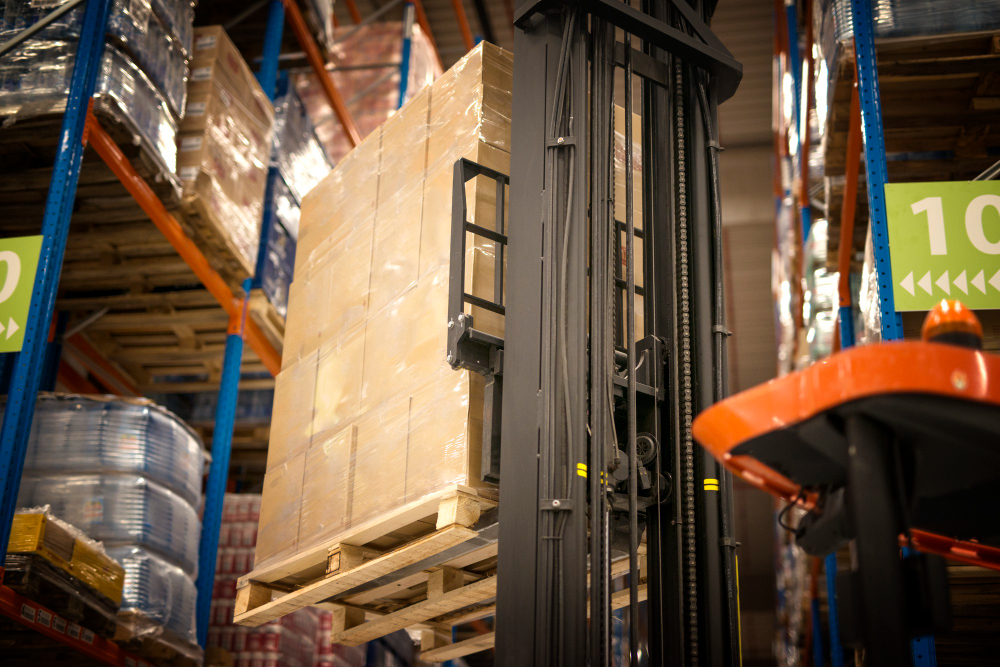
More than shelving and forklifts are needed to run a warehouse. On that floor somewhere, a hoist lifts a pallet onto a rack, or a sling holds a bundle of steel, or a clamp moves a sheet of plate without a scratch. In terms of choosing the right material handling equipment for warehouses in India, it’s important to understand what each tool really does, rather than grabbing what’s on the top shelf of a catalogue. Here is a list of 15 types of equipment that you will see again and again in Indian warehouses, from brands that are actually stocked and supplied in the market. Starting with Elephants. Why the Right Equipment Choice Matters ‘Warehouses are moving materials all the time, day in and day out. A hoist rated for the wrong load, or a sling that wears out faster than you anticipate, becomes downtime and a safety risk very quickly. Dependable material handling equipment for warehouses in India means fewer breakdowns, safer lifts, and gear that lasts for years of daily use. With that in mind, here are 15 types of equipment you need to know about before making your next purchase. 1. Elephant Manual Chain Hoists The Elephant C21 and H-100 series manual chain hoists are a warehouse staple when you need to hoist pallets, machine parts, or racking components without the need for power. They’re easy to use, easy to maintain, and priced for everyday use, not just for those occasional emergencies. 2. Elephant Electric Chain Hoists The Elephant Alpha and Beta series electric chain hoists are designed for repeated lifting cycles. They are available as single-phase and three-phase versions. These suit loading bays and assembly areas where speed is more important than a fully manual setup. 3. Yale Hand Chain Hoists and UNOplus Lever Hoists Warehouse teams turn to Yale’s hand chain hoists and the UNOplus ratchet lever hoist for a manual lifting solution built for durability. The UNOplus design keeps servicing simple, which is important when a hoist runs several times a shift. 4. Yale CPEF Electric Chain Hoists The Yale CPEF range is available from 1,600 kg to 10,000 kg capacity and can be supplied with either hook suspension or as a trolley version. It’s a well-suited choice for warehouses that move heavier loads to racking or transport vehicles. 5. Yalelift 360 ATEX Hoist Hazardous-area-rated equipment is required for warehouses that store flammable materials or are near dust-prone areas. The Yalelift 360 ATEX hoist is certified for such environments, so lifting won’t be the weak link in a facility’s safety plan. 6. STAHL ST Chain Hoist The STAHL ST chain hoist is of compact design, strong and built for continuous duty. In multi-shift warehouse operations, this hoist outlasts lighter-duty models, which wear out faster. 7. Tiger TAH Pneumatic Air Hoists The Tiger TAH52 and TAH250 pneumatic air hoists offer a wide capacity range from 5 tonnes to 60 tonnes. Air hoists are good for warehouses near flammable storage, as they cannot ignite as electric motors can. 8. Tiger Tigrip Load Indicators A Tigrip TZL or TZR load indicator gives the operator a real-time indication of what hoist is lifting. That’s a handy safety net for warehouses that deal with mixed or unmarked loads. 9. Tiger Tigrip Container Spreaders Warehouses and yards can safely handle standard shipping containers with the Tigrip TCO and TCU container attachments. This is important for facilities that are involved in logistics and freight movement. 10. Yoke Lever Hoists and Trolleys Yoke also offers lever hoists and chain block trolleys for lifting and horizontal movement of loads along overhead beams. They are often paired with warehouses that need to move loads sideways, as well as up and down. 11. Bridon Bekaert Wire Ropes Wire rope quality impacts every lift downstream. Bridon Bekaert’s Tiger Blue 8 spiral strand rope, the Zebra rope and the Tiger Big T6 spiral strand rope feature in Indian warehouses running cranes and wire rope hoists that require reliable, long-lasting cable. 12. Thiele Chain Slings and Fittings Thiele chain slings, welded master links, wire slings and G100 four-leg chain sling fittings are used to secure loads in lifts and during transport. These parts link a hoist to the actual pallet, bundle or crate being moved, so they are as important as the hoist itself in a warehouse. 13. Ludwig Plate Lifting Clamps Ludwig clamps, including the Bulli, Choker and Traverse ranges, girder stacking clamps and rail clamps, handle steel plate and sheet stock without the guesswork of improvised rigging. This type of clamp is used in warehouse storage of flat steel stock for rapid and safe movement of material. 14. Safelift Rigging Accessories Safelift shackles, eye bolts, and lifting points are small hardware for connecting loads to hooks and slings. These parts are under constant stress, so having the same quality of each shackle and eye bolt in a warehouse is more important than you may think. 15. Maxpull Winches Maxpull’s electric and manual winches in stainless steel are used for pulling and tensioning jobs a hoist can’t do, like dragging equipment into place or tensioning cables when setting up. If you work in a warehouse with outdoor storage or loading docks, they typically have a winch available for such cases. How to Choose Between These Options Not all 15 items have to be in every warehouse. Here is a quick way to narrow the list: First, check your load range. Match the hoist and clamp capacities to your heaviest regular lift, not just your average lift. Consider the lift frequency. Occasional lifts are good for manual gear such as Elephant or Yale hand chain hoists. If you need to repeat the lifting, you should use an electric or pneumatic hoist. Consider your storage environment. Standard electric hoists are not suitable for use in areas with flammable materials or dust. Use ATEX or air-powered equipment. Don’t forget the small hardware. Hoists are less likely to fail from wear than shackles, master links and sling fittings, so replace