

10 Factors Affecting Selection of Material Handling Equipments
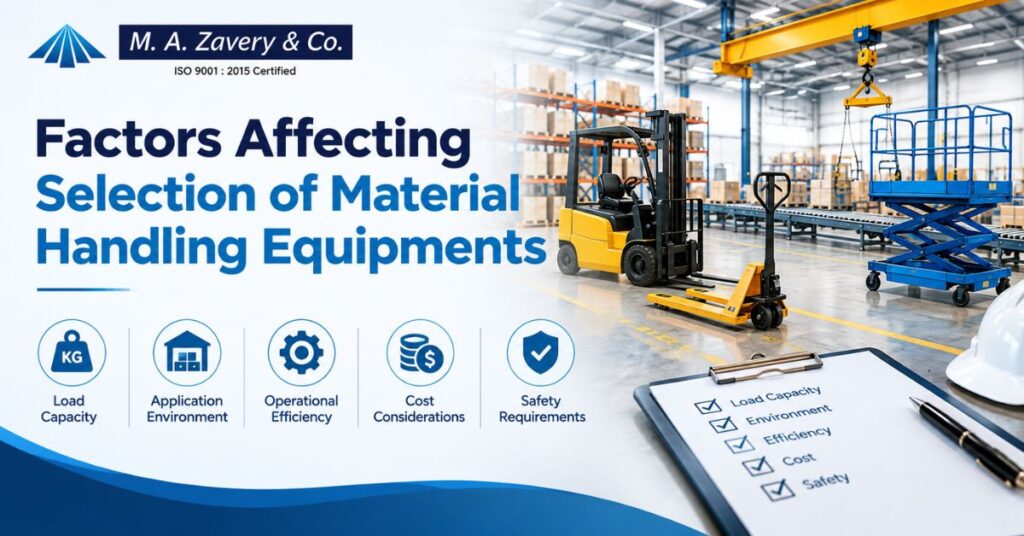
Choosing the right machine to move goods around a warehouse, workshop, or construction site is not a guess. It affects worker safety, daily production, and costs years after the purchase order is signed. A hoist rated too low will be overworked. A trolley picked without regard to the floor space will jam up the very aisle it was meant to clear. This guide discusses the 10 factors that influence the selection of material handling equipment, based on established engineering guidance and safety standards. Let’s take it one factor at a time, starting with the load itself and then passing through space, power, safety, and cost. What Counts as Material Handling Equipment? Material handling equipment is any type of machinery used to move, store, lift or control materials during the manufacturing, storage or transportation process. These include manual chain hoists and lever hoists to electric wire rope hoists, pneumatic hoists, winches, cranes, trolleys and rigging gear, including slings, shackles and lifting clamps. Some jobs require a simple hand stacker. Some demand a three-phase electric hoist to be fixed to a monorail. Below are factors to consider for the right fit. Why the Right Choice Matters Getting the wrong decision on this can cost more than the price tag on the machine. Equipment that is too small wears out fast and strains the operator. Large equipment is a drain on space and money. Poor equipment choices increase the likelihood of dropped loads. This is backed up by government data on work injuries: back injuries due to manual lifting make up a significant share of all reported injuries at work in the US, with most of these injuries affecting the lower back (Source: “2025 OSHA Material Handling Guidelines: Lifting, Pushing, Pulling”, Wakefield Equipment, 2025, https://wakefieldequipment.com/osha-material-handling-guidelines/). That fact alone explains why equipment selection deserves serious consideration rather than a quick catalogue pick. 10 Factors Affecting Selection of Material Handling Equipments 1. Properties of the Material Being Moved Don’t catalogue; start with the load. Weight, shape, size, and surface condition all dictate what type of hook, grab, sling, or clamp the job calls for. A smooth steel coil requires different rigging than a rough concrete segment or a hot, greasy part. According to engineering specialists, the weight, dimensions, and surface finish of a load (greasy, hot, or rough) determine the design of the hooks, grabs, or magnets used to lift it. (Source: “How to Select Material Handling Equipment?”, Airpes, 2025, https://www.airpes.com/how-to-select-material-handling-equipment/) “Measure twice,” they say, because getting this wrong at the design stage can lead to serious failures down the line. 2. Load Capacity and Weight Every piece of lifting gear comes with a rated capacity, and that figure should never be viewed as a target to achieve, only a ceiling to stay beneath. Industry advice on this is clear: choose equipment that is strong enough to lift the load with some spare capacity, but not so oversized that it unnecessarily drives operating costs up (Source: “Factors Affecting the Selection of Material Handling Equipment”, LinkedIn Pulse, https://www.linkedin.com/pulse/factors-affecting-selection-material-handling-equipment-namdas-arvind). That’s why rated capacity plates are placed on hoists, trolleys, and slings, and the OSHA rigging rules prohibit this rating from being exceeded. 3. Facility Layout and Available Space The aisle width, the door height, and the overall footprint of the work area all limit what will fit. In a tight ceiling height, a low headroom hoist may be the only realistic option, and a compact electric stacker might be better than a full gantry crane in a narrow storeroom. Training material used across East African logistics bodies also flags the same point. Available floor space, floor condition, and clearance height all shape which equipment can physically go into a site. (Source: “Factors to Consider in Selecting Materials Handling Equipment”, FEAFFA LMS, https://lms.feaffa.com/topic/factors-to-consider-in-selecting-materials-handling-equipment/). 4. Floor and Structural Strength A crane or heavy hoist puts real stress on the floor and structure beneath it, not just the hook. Before ordering equipment, make sure that the floor can support the combined weight of the machine and the load, as well as the stresses of repeated operation over time. Questions to ask ourselves: What is the maximum load that the floor can take? How often can the structure be moved, again and again, without being damaged? Does the building need to be reinforced before installing? 5. Production Flow and Movement Pattern The equipment required is changed by the way goods move through a site. A monorail hoist or conveyor is well suited to a steady, fixed path between two points. A variable flow where loads go to different locations on different days is often better served by a mobile crane, trolley or manual stacker. The right equipment for the right flow pattern means you’re not paying for automation you don’t need or shoving flexible work into fixed ways of working. 6. Speed of Movement Some jobs need a quick turnaround; some do not. The same industry guidance says that the speed at which materials move needs to be kept within the limits of the production process and the safety of workers and not pushed for the sake of speed (Source: “Factors Affecting the Selection of Material Handling Equipment”, LinkedIn Pulse). An electric hoist is quicker than a hand chain hoist, but the advantage of speed is only there if the rest of the process can keep up. 7. Power Source and Level of Automation Manual, electric and pneumatic equipment suit different settings. If there’s no power point nearby and you only need to lift occasionally, a manual chain hoist is fine. Electric hoists can be used for repeated daily lifts where speed and less physical effort are important. Pneumatic (air) hoists are very suitable for hazardous zones with flammable dust or vapour, as they eliminate the risk of electrical sparking. The level of supervision of the task on a day-to-day basis is also affected by the degree of automation of the equipment. 8. Safety and Regulatory Requirements There’s a bloody good reason rigging and lifting equipment is regulated. Under US
Elephant Hoists for Manufacturing Plants: Continuous-Duty Lifting Explained
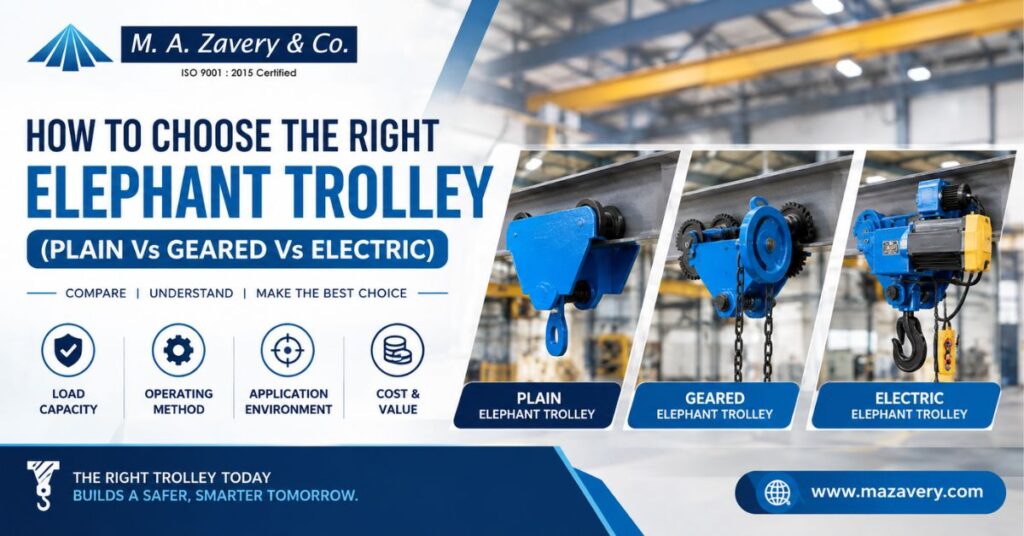
A production line that stops any time a hoist gets too hot is a fast way to lose money. Plant managers who select lifting gear that is only meant to be used on occasion in the workshop often learn the hard way that it doesn’t cut it once the equipment is in the real manufacturing cycle. Elephant Hoists have a different design brief. They are built for repeated lifts, long shifts, and loads that keep on moving all day long without a break. This guide will help explain what continuous-duty lifting really means, how duty cycle ratings work, and what kind of hoist belongs on a manufacturing floor versus a maintenance bay. Quick Answer: What Counts as Continuous-Duty Lifting A continuous-duty-rated hoist can run for long periods of a shift, start and stop frequently, and carry loads close to its rated capacity without overheating or wearing out prematurely. To summarise, look for: H3, H4, or H5 duty cycle rating per HMI/ASME A motor designed for 25 to 100% running time per hour A brake and gear train for frequent, not occasional, starts Chain or wire rope grades matched to number of daily lift cycles Factory and assembly-line work is covered by electric chain hoist series and manual hoists for lighter, intermittent use. Elephant Hoists cover this range. Why Duty Cycle Rating Matters More Than Lifting Capacity Two hoists can have the same tonnage rating but perform very differently on the factory floor. Capacity tells you how much weight a hoist can lift. The duty cycle tells you how hard and how often it can lift that before something wears out. Industry groups, such as the Hoist Manufacturers Institute (HMI) and the American Society of Mechanical Engineers (ASME), classify hoists based on load spectrum, daily operating time, and frequency of starts. The European Federation of Materials Handling (FEM) and ISO have parallel systems, but each standard has a different name. H1 and H2: Light and Infrequent Use Light and Infrequent Use. Use H1 hoists for suitable powerhouses and utilities and for infrequent handling where loads occasionally approach capacity and the hoist sits idle for long stretches between use. H2 consists of light machine shop work with loads and usage at random throughout the day, with total running time less than 12.5% of the work period. These classes are good for a maintenance bay. They are not the right choice for a manufacturing line that runs a hoist for hours at a time. H3: General Manufacturing and Assembly H3 is for general machine shop fabricating, assembly, storage, and warehousing with randomly distributed loads and utilisation and total running time of less than 25% of the work period. Many mid-volume manufacturing plants are comfortably within this range. H4 and H5: High-Volume and Heavy Service H4 is for heavy loads, generally at rated capacity, and high volume, such as steel warehousing, machine shops, mills, and foundries. Running time up to 50% of the work period. H5 is at the top end for bulk handling, with attachments like buckets or magnets that operate near constantly through a shift. If a plant operates two or three shifts with repeat lifts near rated load, H3 or higher should be specified. Guessing on this rating leads to premature motor burnout, brake wear, and stalled production lines, a pattern lifting equipment specialists say appears when a hoist is specified for the wrong operating intensity rather than the wrong lifting capacity. Elephant Hoist Series Built for Manufacturing Lines Elephant is a Japanese brand of lifting equipment. It is known for its rugged construction and steady load control in tough industrial environments. The electric range has single-phase and three-phase models for the actual running hours that a manufacturing plant needs. Electric chain hoists of the Alpha and Beta series are available in variable- or constant-speed versions with single- and three-phase power supplies. They are matched up with plain, geared or electric trolleys by plants, depending on the distance the load has to go on a monorail or runway beam. SA, FA/FB and DA/DB series step up in capacity and running-time tolerance for heavier, higher-volume applications. These electric hoists with hook suspension are ideal for assembly. lines, packing stations and heavy warehousing where the same lift is repeated hundreds of times a day. Hand-operated C21 and H100 series manual chain hoists are still in use for maintenance work, workshop lifting and light-to-medium tasks where power is unavailable or not required. They are not designed for continuous production cycles, but they are a convenient backup for spot lifts around a plant floor. M.A. Zavery is a full-line elephant supplier, including genuine stock obtained through authorised channels. Its technical team assists manufacturing customers in matching hoist series to actual duty requirements rather than guesswork. Features That Support Continuous-Duty Performance A hoist that is rated for factory floors is different than a light-duty unit in several specific ways: Motor insulation class and duty rating. Continuous-duty motors have insulation rated for continuous heat buildup, not for short bursts. Brakes. A hoist that makes dozens of starts and stops every hour needs a brake designed for that wear pattern, not one designed for infrequent use. Material of gear train. Tempered gears are less susceptible to repeated near-capacity loads than standard-grade components. Chain and hook rating. Galvanised load chains are resistant to wear from repeated cycling and stand up better to plant-floor conditions than untreated chains. Works with trolleys. “Trolleys, either geared or electric, are useful for moving loads along a fixed path, reducing manual effort when transferring loads repetitively. How to Choose the Right Elephant Hoist for Your Plant Here’s a short list of requirements for choosing a hoist for a manufacturing environment: Log your lift cycles each day. Estimate the number of hours the hoist will be operating during peak production. Look at your load %. Determine how close your average lift is to the hoist’s rated capacity. Match the duty class. Manufacturing Lines. Don’t just use H1 or H2 equipment, sold for general workshop
Types of Material Handling Equipment in Warehouse
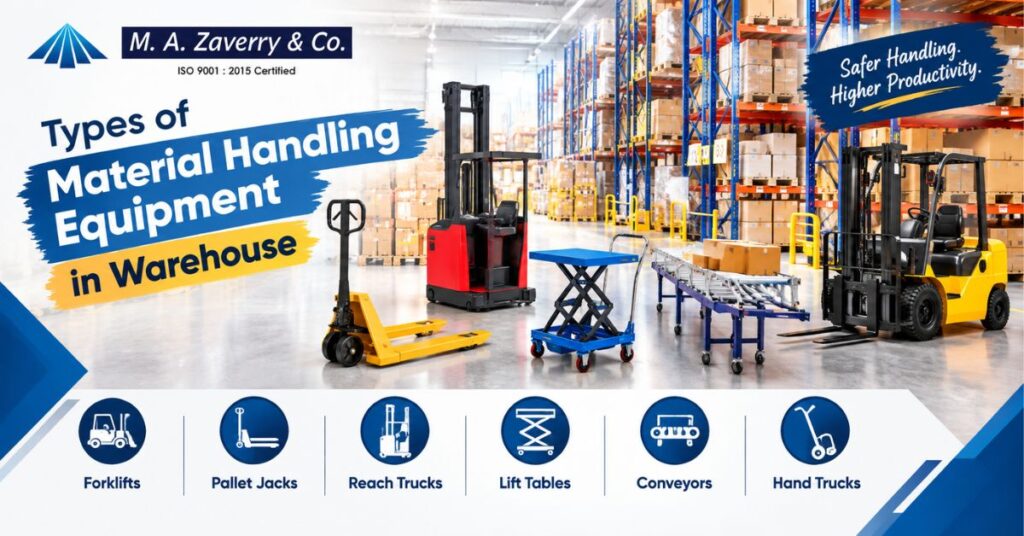
Walk into any busy warehouse, and you’ll see the same pattern. Pallets are coming off the trucks, stock is going toward the racking, and orders are being picked and packed for the next shipment. All of that’s not done by hand anymore. That’s what it is, that somebody picks the right equipment for every part of that flow. This guide will take you through the main types of material handling equipment in warehouses, what each one does best, and how to match equipment to your actual operation, as opposed to buying what’s popular. What Is Material Handling Equipment? Material handling equipment, or MHE for short, is the general term for the machines and tools used to move, lift, store, and protect goods within a facility. In a warehouse specifically, that can be anything from a hand truck to move a single box to a fully automated 24/7 storage and retrieval system. Most equipment in this space can be grouped into a few functional categories: • Transport equipment, which moves goods from one point to another • Storage equipment, which organises and protects inventory • Lifting or positioning equipment, which raises, lowers, or angles a load at a fixed location. Typically, warehouses use a combination of all three, the right combination depending a lot on the size of the facility, the type of goods being handled, and the frequency of stock turnover. Why Equipment Choice Matters in a Warehouse Choosing the wrong gear is quickly apparent in a warehouse. Increases order fulfilment times. Workers are bending their backs, lifting things a machine should be doing. The aisles get blocked because the forklift can’t make the turns it needs to make. Here’s why this matters beyond everyday convenience. Manual lifting and repetitive carrying are two of the largest contributors to musculoskeletal injuries in warehouse work, and those injuries represent a large part of lost workdays across the industry. Powered equipment removes a lot of that physical strain, but it needs to be the right size and type for the job. And there is a compliance angle too. Powered industrial trucks are regulated by the Occupational Safety and Health Administration (OSHA) under 29 CFR 1910.178. Forklifts alone are linked with approximately 70-85 workplace fatalities and tens of thousands of serious injuries each year in the United States. It’s not just paperwork to get the equipment selection and operator training right. It’s the difference between a warehouse working safely and a warehouse waiting for something to go wrong.” Types of Material Handling Equipment in Warehouse Operations Let’s review the types of equipment you will find in most warehouses, beginning with the most common and working our way to the more specialised. 1. Forklifts Forklifts are the backbone of warehouse materials handling. They lift, haul, and stack palletised loads and are used for everything from unloading delivery trucks to placing pallets on high racking. OSHA divides forklifts into seven types, ranging from electric-motor rider trucks used inside to rough-terrain forklifts for rough outdoor terrain. Each class requires its own training and certification, and just because an operator is certified on one type doesn’t mean they’re automatically good to run another type. For example, a counterbalance forklift and a reach truck need different aisle widths and different handling techniques, although both are classified as forklifts. 2. Pallet Jacks A pallet jack (or pallet truck) has two forks and a hydraulic pump which allows it to raise and move one pallet at a time. Manual pallet jacks are good for short, infrequent moves. Electric pallet jacks are sometimes called walkies or rider trucks. They are powered by a battery-powered motor and can do longer runs or heavier loads without tiring the operator. Neither type lifts to the height of racking, where forklifts and stackers enter the picture. 3. Stackers Stackers are somewhere between pallet jacks and full forklifts. A hand stacker is manual. It is good for lighter loads at moderate heights. An electric stacker handles heavier loads and taller lifts with less physical effort. Stackers fill this gap for warehouses that move a lot of palletised goods each day but don’t need the full lift range of a forklift. 4. Order Pickers Order pickers raise the operator to the height of the shelf so they can select individual items without having to climb a ladder or continually move equipment. This is most critical in facilities that handle large volumes of piece-level order fulfilment, where speed and accuracy on each pick directly impacts how quickly orders get out the door. 5. Conveyors Conveyors move goods along a fixed path; no person carries each item by hand. They most commonly exist in receiving, sorting, and shipping areas where the same type of material is flowing back and forth between two points. A conveyor system is not going to replace a forklift in moving pallets around a warehouse, but for a continuous, high-volume flow along a set route, nothing delivers the consistency of a conveyor system. 6. Pallet Racking and Shelving Storage equipment such as pallet racking and shelving stores inventory vertically and is a much better use of available floor space than just stacking goods on the ground. Good racking design reduces product damage and makes it easier to know what’s stored where. Most warehouses connect racking systems directly to the forklifts and order pickers that access them, so the two should be planned together rather than as separate decisions. 7. Hand Trucks and Platform Trucks Hand trucks have a metal frame and toe plate and are used to move smaller, lighter items around a facility without the use of hydraulics or a motor. Platform trucks take that idea a step further, with a wider platform and four wheels instead of two, which means they can carry bulkier loads over short distances. Both are simple, cheap tools for moves that don’t need a forklift or pallet jack. 8. Sideloaders A sideloader is a type of narrow-aisle forklift. The operator’s cab is mounted alongside the vehicle rather than