

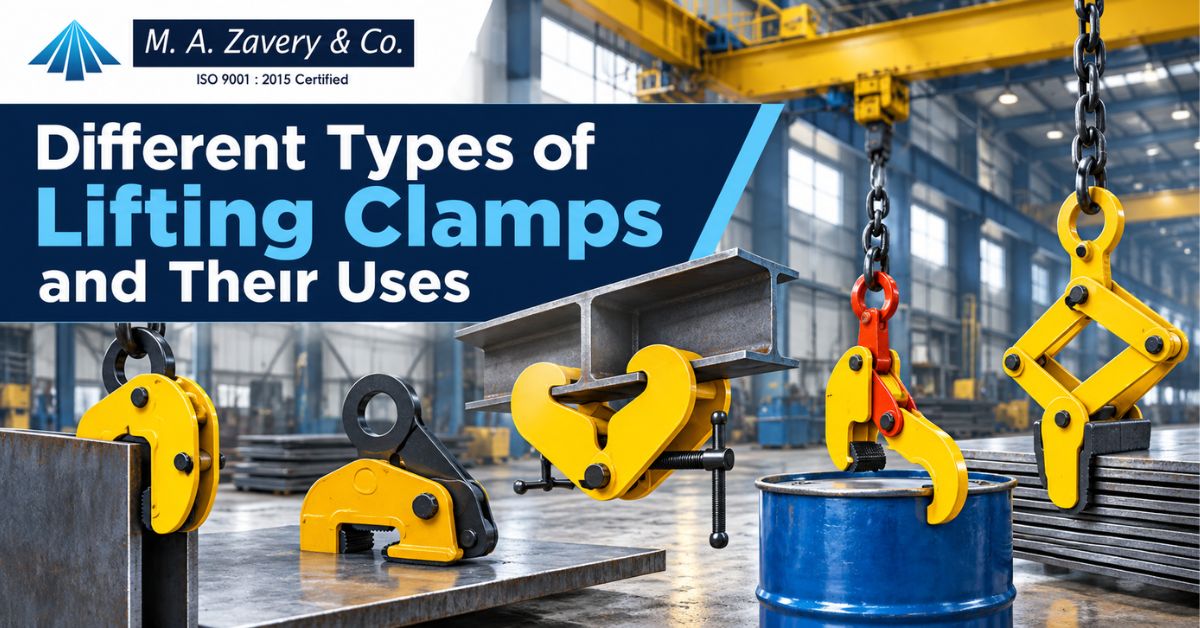
Choose the wrong clamp, and the load tells you fast. A plate slides, a beam tips, or a pipe rolls out of the jaws. Pick the right one, and the lift feels dull – exactly what you want. So let’s look at how each clamp style works, where it fits, and how to choose.
Short answer: six main types of lifting clamps.
- Vertical plate clamps – lift and rotate steel plate from flat to vertical.
- Horizontal plate clamps. Used in pairs to hold the plate flat.
- Beam and girder clamps are used to grip a beam flange to lift or hang equipment.
- Pipe and round stock clamps – these hold round loads that want to roll.
- Rail clamps: select single rails or bundles of rails.
- Screw clamps: adjustable, controlled grip, threaded pad.
That’s what they’re there for.
What Is a Lifting Clamp?
A lifting clamp is a grip-type device below the hook. It attaches mechanically to a plate, beam flange, or pipe wall to create a lifting point. You attach it, hook it up to a hoist or crane, and lift it sans drilled holes or welded lugs.
Most clamps hold objects in two basic ways. Cam clamps have a cam that is spring-loaded, and that bites harder as the tension increases. Screw clamps use a threaded pad which the operator tightens by hand. One supplier says the cam clamps force-hardened steel teeth into the plate when the load pulls on them. Most vertical plate clamps use a cam, which provides a clamping force that increases with the load, hoist industry writers add.
ASME B30.20 is the safety rule for below-the-hook lifting devices. Each clamp is rated by the manufacturer for a specific orientation. Always check that rating first thing.
Types of Lifting Clamps at a Glance
| Clamp type | Grips | Orientation | Typical use |
| Vertical plate clamp | Plate edge | Lifts plate upright or turns it | Fabrication, shipyards, loading, cutting tables |
| Horizontal plate clamp | Plate edge, flat | Keeps plate flat | Stacking, moving plates, loading presses and shears |
| Beam or girder clamp | Beam flange | Vertical or horizontal | Lifting I-beams, stacking girders, hanging hoists |
| Pipe or round stock clamp | Cylinder surface | Varies | Pipe yards, bar stock handling |
| Rail clamp | Railhead | Horizontal bundles | Rail yards, track work |
| Screw clamp | Any gripped edge | Varies | Positioning and controlled grip |
Plate Lifting Clamps
The largest family is that of the sheet and plate clamps. Industry guides divide them into two basic types: horizontal and vertical plate clamps.
Vertical Plate Clamps
A vertical plate clamp grips the edge of the plate and lifts it upright. These are the most common clamps in plate shops. A spring-loaded cam bites into the face of the plate, and most designs have a safety latch that locks the clamp once it’s engaged.
Fabricators use them to turn plates from flat to upright, load plates onto cutting tables, and load trucks. One supplier offers models with turning up to 180 degrees. There are two rules:
- A vertical clamp lifts one plate at a time.
- Do not use it to move a plate sideways. The clamp can be damaged, and the load dropped if a vertical clamp is used for a horizontal pull.
Horizontal Plate Clamps
Vertical clamps slide over the edge of the plate and hold it flat. Industry writers say horizontal clamps are only for plates laid flat. Usually used in pairs, connected by a two-leg sling or a lifting beam. Long plates may take more than one pair.
A good example is Camlok THS. It is designed for horizontal plate handling. The THS suits loading plates into presses, shears and guillotines, and can work alone for short plates, say, makers. If two are used, the sling angle from the vertical shall not exceed 30 degrees. A spring-loaded safety lock keeps it closed on the plate ahead of the lift. Camlok cautions against using it on stainless steel, lead, or copper and requires a maximum plate hardness of 300 Brinell.
Multi-Directional Plate Clamps
Some clamps cover both orientations. They have two suspension holes, one for vertical and one for horizontal lift. They are great for shops that do a lot of different things with plates and want fewer clamps on the rack.
Beam and Girder Clamps
Beam clamps wrap their jaws around a flange of the beam. The jaw shape is different from a plate clamp, as the clamp body needs to maintain the beam in its intended orientation during the lift. Not all beam clamps lift vertically and should never take a side load.
Special version of Camlok TTR girder stacker clamps. The TTR carries girders in the H position and keeps them almost horizontal, making it easier to place them into saw vices, punches, and storage stacks. An offset suspension lug sets the balance point, and the clamp is secured to the vertical flange with a jaw locking lever. For short girders, use one clamp. For longer ones, use a pair with a spreader beam. The maker quotes a design factor of 4:1 and a working load limit from 50 to 3,000 kg across the range. See the product page for the model you need.
Its main users are steel stockholders and fabricators. A beam clamp has another use: it provides a quick suspension point for a hoist. In this role, ensure that the clamp rating includes the hoist and the load.
Pipe and Round Stock Clamps
Rolling loads are risky because they roll. Pipe clamps have either a scissor action or curved jaws to grip the pipe. They also have a rear tube and round bar.
Camlok TRU round stock grabs are good for this job. The manufacturer says the TRU can handle round stock and pipe up to 600 mm in diameter with a working load limit of 100 to 4,000 kg depending on the model. Optional protective lining allows it to handle easily scratched surfaces. When applying the lining, all surfaces must be dry, clean, and free of oil and grease. The maker also points out that no shackles are supplied.
M.A.Zavery has a separate category of pipe lifting clamps on its home page. Before ordering, open that category and see what the diameter range and rating are for each clamp.
Rail Clamps
Rail handling has its own clamps since railheads are narrow and rails are long.
- Camlok CR single rail clamps. These lift one rail at a time. A spring mechanism operated by a lever holds the clamp onto the head of the rail. The manufacturer states that the working load limit is 1,000 to 2,000 kg and that the narrow profile means the clamp can be attached to one rail even when the rails are side by side. Long rails: Use clamps suspended from a lifting beam.
- Camlok MR Fixed Multi-Rail Grabs. They move bulk rail of one section size. There are swivelling toes underneath the rail head and a rubber-lined contact beam on top so it does not mark the rail. The manufacturer states a working load limit of 5,000 to 8,000 kilograms. It recommends two clamps for rails up to 20 metres long and three for longer rails. Rails are stacked flange to flange, and all are of the same section.
Screw Clamps and Speciality Clamps
Screw clamps use a threaded pad rather than a cam. The grip is controllable and adjustable by the operator’s hand tightening the screw. One supplier says screw clamps are suitable for applications where a cam lock does not fit. They are good for placement jobs.
Speciality clamps include lifting drums, concrete blocks, and piles. Some vertical clamps even release remotely for pile driving.
How to Choose the Right Lifting Clamp
Follow these 6 steps.
- Load the name. Plate, beam, pipe, rail, or drum?
- Choose the orientation. Vertical lift, flat carry, or flat-to-upright turn?
- Ensure total weight (including rigging) does not exceed the working load limit. Verify if the load is close.
- Check grip range. If the plate is thinner than the minimum specified, the cam will not lock, and the load can slip. Check the thickness and width range on the data sheet.
- Check the material. Surface hardness, coatings, and fragile finishes all matter. Some clamps are limited to 300 Brinell, and some should not be in contact with stainless steel, lead, or copper.
- Choose single or double. For long plates and girders, two clamps and a spreader beam are required.
Next, make sure the clamp meets local rules and your site policy.
Safety Rules for Every Lifting Clamp
- Use the clamp only in the rated orientation.
- Do not exceed the working load limit.
- Check jaws, teeth, cam, springs, and locks prior to each use.
- Clean the gripping area of oil, paint, and scale.
- Do a short test lift, then check the grip.
- Never stand beneath a suspended load.
- “Only trained people should repair clamps. Camlok says repairs must be done by a trained individual.
- Document and retire damaged clamps.
Pair clamps with line rating. The M.A.Zavery site lists Yoke G100 chain slings, an X-A06 G100 4-leg assembly, Thiele shackles, and lifting points.
Lifting Clamps Listed by M.A. Zavery
has been supplying hoists, winches, wire rope and rigging equipment throughout India from its base in Kolkata. Its site lists a clamping category with Camlok clamps by CMCO, including:
- Girder Stacking Clamp TTR
- THS Clamp for Lifting
- Round Stock List TRU
- Rail Clamps CR
- MR Fixed Multi-Rail Grab
Also mentioned are pipe lifting clamps and Thiele lifting points such as the TWN 1827 weld-on point and TWN 1896. For hoists to match, see the Elephant manual hoists and Stahl chain hoists on the same site. Check ratings and ranges on the individual product pages, as manufacturers publish different capacity tables by region.
Next Steps
Once you know the kinds of lifting clamps that fit your work, here is a short plan:
- Make a list of the loads you lift most – material, weight, and size.
- Mark which way you want each lift to go.
- Measure the thickness of the plate, width of the flange, or diameter of the pipe.
- Refer to the data sheets for working load limit and grip range.
- Long load spreader beam or sling plan.
- Develop an inspection schedule and instruct operators.
FAQs
What are the main types of lifting clamps?
The main types are vertical plate clamps, horizontal plate clamps, beam and girder clamps, pipe and round stock clamps, rail clamps, and screw clamps. Each group holds a different shape and is adapted to a different lifting direction.
What is the difference between a vertical and a horizontal plate clamp?
A vertical plate clamp lifts the plate to vertical or rotates it from flat to vertical. A horizontal plate clamp carries the plate flat, usually in pairs with a two-leg sling or lifting beam. Using one for the other’s job risks the load being dropped.
Can I use one clamp to lift a long plate or girder?
Single clamp for short loads. For longer plates and girders, use two clamps with a spreader beam to maintain the load balanced. This is the exact combination Camlok recommends for its THS plate clamps and TTR girder clamps.
How do I know a lifting clamp fits my plate or beam?
Refer to the data sheet for grip range, working load limit, and maximum surface hardness. If the plate is thinner than the minimum grip, it can slip away. Measure your material first and find the matching clamp.
How often should I inspect lifting clamps?
Inspect jaws, teeth, cams, springs, and locks before each use and keep a written record. Take any damaged clamp out of service. Repairs should be done by trained people, and local rules may have additional requirements.