

How Does Safety Clamp Work in Lift?

Every day you get in a lift and trust it to stay on its tracks. That trust relies on a device most people never see: the safety clamp. The safety device, known to engineers as the safety brake or safety catch. It is a mechanical brake that grabs the guide rails and stops the car if it is going too fast or if it loses its ropes. Let’s go over how it works, what sets it off, and what keeps it primed. A quick note about the word “lift”. It means a lift for passengers or goods in India. Safety clamps and latches are also used on lifting equipment like hoists, and I cover that meaning toward the end. Quick answer: 5 steps to operate the safety clamp. During normal travel, the clamp’s wedges or rollers are clear of the guide rails with a gap of a few millimetres. The car accelerates too quickly, or the suspension ropes snap. The overspeed governor trips and takes its own rope. The held rope pulls on a linkage that forces wedges or rollers against the rails. That clamp bites, stops the car, and holds it while an electrical switch cuts power to the machine. Here’s why each step occurs. What Is a Safety Clamp in a Lift? A mechanical safety gear called a safety clamp is mounted on the car frame. It straddles the steel guide rails that run the whole height of the shaft. When activated, it locks onto the rails to stop and hold the car. Industry sources refer to the same idea by several names: Safety Equipment Safety Chain Brake Safety catch (old British term) Clamp wedge “Under Indian rules, it is required to be carried. IS 14665 Part 2 has a summary on the overspeed governor and safety gear as mandatory, and IS 14665 Part 4 has a section on lift safety gears and governors. The safety clamp is separate from the ropes and the motor. One guide for home lifts describes the logic nicely: the governor is the sensor and trigger, and the safety gear is the muscle that physically stops the car. The Parts That Make It Work Five main parts come together. Overspeed governor: A sensor, usually at the top of the shaft, that senses speed. It spins with a flyweight mechanism at a speed relative to the car speed. Governor Rope: A rope looping around the governor and tied to the car. It moves with the car Lift rod or linkage: Connects the governor rope to the safety gear on the frame of the car. Wedges, rollers, or cams: hardened blocks located inside the safety gear housing. They hang on the rails. Guide rails: Steel machined rails that the clamp bites against. And also in the chain is an electrical safety switch. When the safety gear works, it cuts off power to the machine. How Does Safety Clamp Work in Lift Systems: Step by Step Step 1: Normal Travel The car runs on the rails, on the guide shoes. The wedges hold back the safety gear that hangs from the frame of the car. A technical source gives a clearance between the wedge and the rail of the order of 2 to 3 mm. No contact during normal riding means the clamp does not wear out. Step 2: Overspeed or Rope Failure Something’s wrong. A rope breaks, the brake gives way, or the car exceeds its limits. The car is beginning to fall too fast. Step 3: The Governor Trips The car goes faster; the governor turns faster. One source says it trips above 115 per cent of the rated speed of the car. Upon tripping, a jaw secures the governor rope to a stationary sheave. Another source calls the signal a mechanical message that runs down to the safety gear linkage. Step 4: The Rope Pulls the Linkage Now the governor rope ceases to move, but the car continues to fall. The downward movement of the car pulls the lift rod through the rope held. This motion either slides the wedges up their sloped surfaces or rolls rollers onto the rail. Step 5: The Wedge Bite and the Car Stops The wedges bear on the machined faces of the rail. The car stops. Friction. Technical sources say the action is self-energising: a harder fall pushes the wedges deeper into the rail. The electrical safety switch cuts off power to the machine at the same time. So the motor cannot continue pulling. The whole sequence is done without electricity, without software, and without the help of the ropes. That’s what independence is for. Instantaneous vs Progressive Safety Gear There are two types of safety gear. It is dependent on the speed and load of the lift. Feature Instantaneous Progressive Stopping action Abrupt, almost immediate Gradual, controlled Deceleration High Kept to a gentle level for passengers Typical use Slow lifts, including many home lifts Faster passenger and goods lifts How it grips Locks wedges or rollers hard into the rail Slides with controlled friction, often using springs The instantaneous type brings the car to a sudden stop, and the progressive type applies braking gradually and reduces the forces on the structure. One source explains that standards classify the type based on rated speed: instantaneous gear for speeds less than about 0.63 m/s and progressive gear for higher speeds. Standards and countries have different limits, so the lift maker must choose the gear that fits the rated speed and rated load. Progressive gear is designed to slow the car down at a rate that passengers can stand, generally characterised as less than 1g. If the shaft has a space such as an office or home below it, the counterweight may also need its own progressive safety gear. What Happens After the Safety Gear Engages The car halts and remains still. What follows is: The car stands still on the rails. The electrical safety device cuts power to the machine. Passengers are advised to remain inside and
Important Role of Material Handling in Logistics
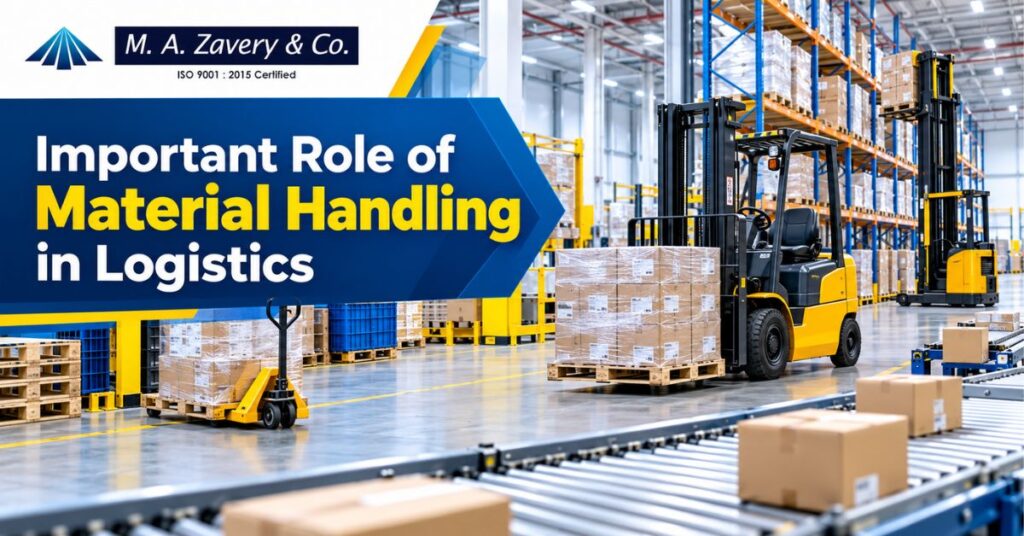
A truck arrives with three drums, forty pallets, and a crated machine. Somebody’s got to unload ’em. Check ’em. Store ’em. Pick ’em. Reload ’em. And not break anything or anyone. And that “somebody” is material handling, influencing almost every facet of a logistics operation. We’ll look at what it covers, where it fits and how to get it right. Quick answer: Material handling is the movement, protection, storage and control of goods within a facility, or between a building and a vehicle. In logistics, it serves six major functions: It handles the movement of goods from receiving to storage to picking to shipping. It safeguards products against damage. It takes strain and injuries off workers. It takes up less space in storage. Accurate inventory control is provided. It helps to keep the labour and handling costs down. Here’s why each one matters. What Is Material Handling in Logistics? Material handling is defined by industry sources as the movement of goods over short distances within a building or between a building and a transport vehicle. It covers the movement, protection, storage and control of materials in warehouses, factories and distribution centres. The job involves packing goods for shipment, loading and unloading vehicles and arranging materials in storage facilities. There are three manners of handling: Manual: Manual lifting, carrying, pushing and stacking of loads. Mechanised Equipment such as hoists, forklifts and conveyors move the load and people control it. Automated: Goods are moved by robots and storage and retrieval systems with little human input. In India, most warehouses and yards are a mix of all three. Where Handling Fits in the Logistics Chain All shipments go through the same steps. Handling is present at each. Receiving: unload the vehicle and inspect the goods. Put-away: The placement of goods in racks, floor stacks, or yards. Storage – Keep your goods safe and make them searchable. PICKING: Collect items for an order. Packing and staging: Prepare order for shipment. Loading: Load the outbound vehicle with goods. Transfer: Transfer loads between docks, yards and vehicles. A weak link at any point delays the rest. A pallet in the receiving bay for six hours causes a backlog of everything that follows it. Material Handling in Logistics by the Numbers India’s logistics sector is big, and its cost is now better understood. The total logistics cost for 2023-24 is 7.97 per cent of GDP and 9.09 per cent of non-services output, a study conducted by the National Council of Applied Economic Research (NCAER) for the Department for Promotion of Industry and Internal Trade (DPIIT) said. Previous estimates of 13 to 14 per cent were based on partial or external data. And the same study takes a hard look at warehousing. It says the average cost is around ?30 per sq ft per month, and manpower is the biggest cost component, accounting for about 30% of warehousing expenses. That last figure is one to be reckoned with. Handling equipment determines how much labour a job requires, and labour is the largest cost in a warehouse. Every time a hoist or trolley takes a lift off a worker’s back, it changes the time and risk.” Seven Roles Material Handling Plays in Logistics 1. It Keeps Goods Moving Smooth handling keeps vehicles turning around quickly and keeps stock flowing between zones. Small delays build up. A slow unload creates a queue of trucks, and a queue creates missed slots and overtime. With the right equipment, a small crew can now unload, position and move loads that previously required a larger crew. 2. It Protects Products From Damage Rough handling damages products. Broken drums, squashed cartons and bent steel cost money. Reduced product damage and waste is one of the major benefits consistently listed in material handling sources. Steady loads due to rated slings, matched equipment and controlled lifting. More control is achieved by crews when slow and steady hoists and smooth trolleys are used to place heavy or awkward items. 3. It Reduces Strain and Injuries Warehouses and docks are messing up people. OSHA’s warehousing guidance identifies improper lifting and overexertion as a primary hazard for back injuries. It offers simple advice: install conveyors, overhead hoists or similar equipment and use powered equipment instead of manual lifts for heavy materials. The NIOSH data adds heft. Musculoskeletal injuries cause about 30 per cent of occupational injuries that resulted in lost time, and material movers have the highest number of overexertion injuries, it says. Lifting, carrying, and moving loads can cause sprains and strains, some of the most common dock and warehouse injuries. 4. It Makes Better Use of Space Good handling makes good use of height and floor space. When equipment can safely lift, position and stack loads, more can be stored per square foot. This is important because rent and space are real costs. Material handling guides note core benefits of better use of space, lower labour costs and less waste. 5. It Makes Loading and Unloading Safer Docks are dangerous and busy. A university guide to loading dock safety lists hazards, including being pinned between lifts, the dock and a trailer; lifting and moving heavy or bulky items; and hazards associated with lifting devices and other moving equipment. Good equipment for the load, clear signals and training will reduce those risks. There is no one loading dock standard in OSHA in the United States. It imposes some rules and general duty requirements to cover dock hazards. See what applies to your own state and country. 6. It Supports Inventory Control “Control” is in the definition. The handling steps determine how quickly the stock is received, located, counted and dispatched. Many handling systems are connected to the warehouse management software that offers real-time data on stock levels, locations and movement. Accurate records in a simple yard are maintained by good staging, well-defined zones and consistent handling. 7. It Keeps Costs Under Control Lower labour needs, fewer damaged goods, fewer injuries, quicker turnaround – all lower cost. The savings
10 Importance of Material Handling Equipment in Food Industry
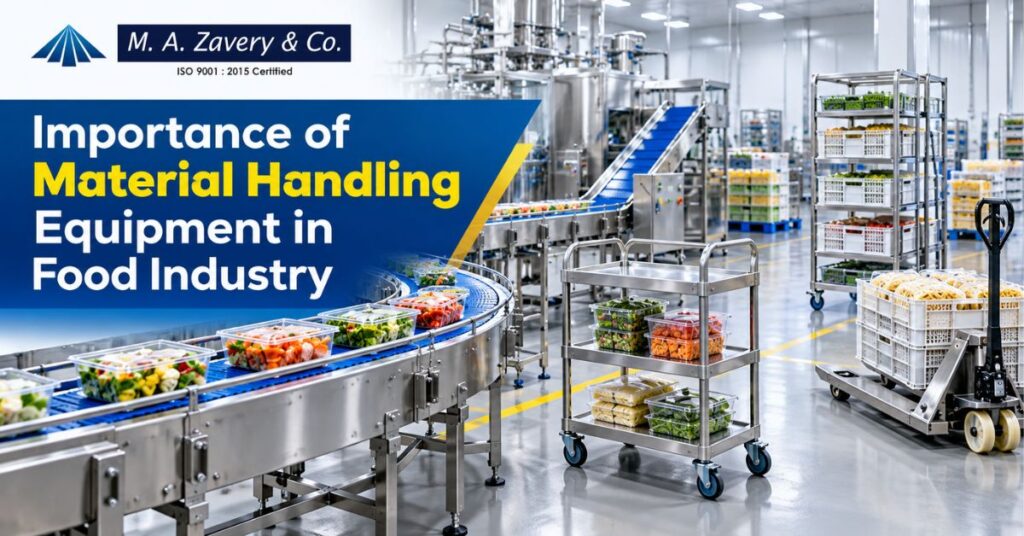
Plants that provide food move a lot of weight. Sacks of flour, drums of oil, stainless vats, motors, conveyors, and pallets all have to be moved somewhere, and they have to be moved safely and cleanly. The equipment that moves it is often an afterthought to the recipe or the packaging line. That’s an error. Here are 10 reasons why the right handling equipment protects your food, your people, and your budget. Quick Answer: Food plants care about handling equipment because it: Encourages food safety and hygiene Contamination from cut risk Prevents injury to workers Keeps production up Limits damage and waste to products Cold chain protection Makes heavy maintenance safe. Decreases dust and explosion hazard Assists with Audits & Compliance Reduces long-term costs This is why they all matter. What Counts as Material Handling Equipment in a Food Plant? The term covers any equipment that lifts, moves, positions, or holds loads. Forklifts, conveyors, and pallet trucks handle the daily product flow. Lifting and rigging gear handles the heavier, less frequent jobs: setting a mixer motor, swapping a pump, lowering a tank, or loading machinery at the dock. The article is based on the second group: hoists, trolleys, floor cranes, winches, slings, and lifting points. They all apply to the whole category alike. 1. It Supports Hygiene and Food Safety Good design is the basis of clean equipment. The FSSAI hygiene rules in India say that equipment and containers that contact food should be made from good-quality materials such as stainless steel or other non-corrosive materials. They should be easy to clean and keep in good condition. US guidance is even more stringent, with food contact surfaces being non-toxic, non-absorbent, non-reactive, non-corrosive, and cleanable, with smooth polished welds and no recessed fasteners. The same logic should apply to handling gear that works near an open product. Sealed joints and smooth surfaces make it easier for dirt to wash away. An exposed-threaded or chipped-coated trolley is a hygiene problem waiting to happen. 2. It Cuts Contamination Risk When a load is moved, something can fall, drip, or rub off. Good handling equipment keeps these risks small. Food-safety standards require that no paint be applied to any surface that comes in contact with food. A product line should be used sparingly, and food-grade lubricant should be used over the product line. FSSAI guidance states that equipment used for food shall not be used for storage of non-food items, and raw and prepared foods shall be stored in separate equipment that is cleaned before each use. Maintenance personnel working in food areas must observe the same hygienic regulations as production personnel. Overhead hoists and lifting points will safely lift a load and keep it off the ground. This lessens drag, spills and contact with filthy surfaces. 3. It Prevents Worker Injuries People tire of lifting heavy loads by hand. A government guide on manual handling in food manufacturing lists common risks from joint and nerve injuries to chronic pain and lists overhead hoists, pallet lifters and height-adjustable trolleys to reduce them. Wherever possible, the first step is to redesign or automate the task. And the data shows this. NIOSH estimates that musculoskeletal injuries account for some 30 per cent of occupational injuries that result in time away from work. Material movers experience the greatest incidence of overexertion injuries. A US health hazard evaluation at a food plant also found that heavy lifting, twisting, and long reaches are associated with a high rate of strains and recommended redesigning equipment to cut the stress of heavy lifting. A chain hoist or lever hoist places the weight on a rated machine, rather than on a person. 4. It Keeps Production Moving Slow, clumsy handling creates bottlenecks. A pallet is sitting at the dock. Four people are waiting for a mixer part. A line sits idle while a motor is swapped out. Mechanical assist devices help workers lift, push, or pull heavy materials. NIOSH associates them with fewer injuries and greater productivity. A tram allows a hoist to travel along a beam. Electric and manual hoists used to require larger crews, but small crews can do a lot of work. 5. It Reduces Product Damage and Waste Rough handling damages food. India’s Ministry of Food Processing Industries has undertaken studies to measure losses at various stages of harvest and post-harvest, such as handling, storage, transportation, and processing. These are attributed to weak supply chain steps, harvesting, collection, sorting, grading, and weak transport and storage facilities, a government reply in Lok Sabha said. The figures tell why this is important. The NABCONS 2022 study found tomato losses to be above 12 per cent, according to a data analysis site. Losses vary by crop and location, but the pattern is clear. Each additional drop, crush, or delay costs product. Lifting gently and carefully will lessen the odds of dings, spills, and broken packs. Slow hoist speeds and smooth trolleys are useful when you put down heavy, fragile loads. 6. It Protects the Cold Chain Chilled and frozen food has a short window. Every hour a load sits on the dock; it gets warmer. Studies in India indicate that fragmented cold chains and slow transport are responsible for the faster spoilage of tomatoes, fish, and poultry. The same data cited a government assessment that found cold-chain gaps in pack houses, ripening chambers, and refrigerated vehicles. Handling equipment can not solve the whole chain, but it does cut the time loads are out of the cold. It all helps to load smoothly, position quickly, and make fewer stops. 7. It Makes Heavy Maintenance Safer Food plants are driven by machines that need servicing: motors, gearboxes, pumps, screw conveyors and mixers. Many weigh hundreds of kilos. Crews cope without proper lifting equipment. A rated hoist, trolley on a beam, and certified slings put you in control of the job. M.A.Zavery: Elephant manual hoists (C21, H-100, Super 100 and DAG 3t), YA Series lever hoist (pulling/positioning), Trolley Series (plain trolley), Yoke G100
How Multiple Manual Hoists Are Used to Lift Heavy Loads?
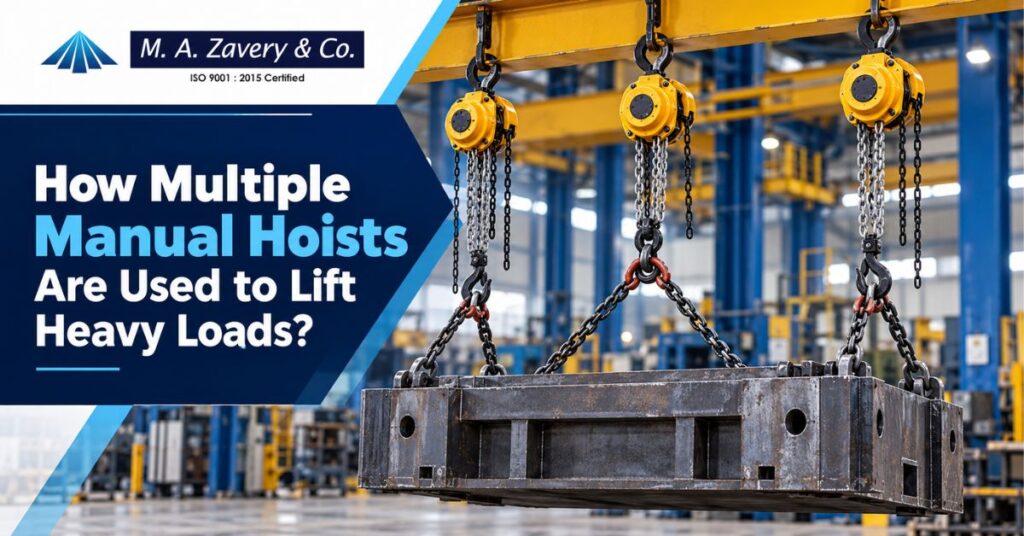
Sometimes one hoist isn’t enough. The load is too long, too awkward, or too heavy for the unit you own. A neat fix would be two or three hand hoists sharing the job. It can work, but it’s one of the easier ways to get hurt if the lift isn’t planned well. This is how crews do it, what can go wrong, and when a single bigger hoist is the better call. Short answer: Yes, more than one hand hoist can lift the same load if the lift is planned and engineered. The basic steps are: Balance the load and locate the centre of gravity. Select lifting points and rated anchors directly over them. “Size each hoist for its share of load plus margin.” Slings and shackles: rig. Rated. Test lift a few centimetres, check level and brakes. Raise in small equal steps with one signalman controlling. Lower it in the same manner and never leave the load suspended. Every step counts. Why Use More Than One Hoist? If one hoist can’t do the job well, crews reach for two or more hoists. Typical reasons are: Heavy loads. Beams, pipes, tanks, and fabricated frames must be supported at two or more points to remain level. Limited equipment. You have two 3-tonne units, not one 6-tonne unit. Close Quarters. Two lifting points prevent long loads from swinging around. Placement of levels. Independent hand chains allow one end to be raised or lowered. Crane operators refer to this as tandem lifting. One industry guide says that splitting the load between lifting units reduces the risk of overloading any one of them and gives better control over the position of the load. The same reasoning applies to hoists. The same guide also warns that an error in estimating the centre of gravity can lead to one unit carrying more than it is supposed to. The Honest Caveat: Why Safety Documents Discourage It Read this part before you rig anything. Multi-hoist lifts are discouraged in many hoist safety documents. Lifting a load using two chain blocks is not recommended, says one university safe-work procedure. The manual says if the job can’t be avoided, it says to hoist with extreme care and keep the load balanced. It’s an easy concern. Hand chain hoists do not include a means of load sharing. Each operator tugs at their own speed. If one end is up faster, the other hoist takes more weight and can overload. One safety article on tandem lifts says that when coordination breaks down, loads can slide out from under the hoists, and the worst case is a broken chain and a dropped load. So, as a last resort, use these lifts. Use if there is a hoist of the right size. If not, plan the lift in writing, and follow these steps: Manual Hoists to Lift Heavy Loads: Common Setups Setup 1: One Hoist With a Lifting Beam or Spreader This is the safer choice, so start here. The anchor has one hoist on it for lifting a lifting beam or spreader beam. The beam distributes the load over a number of pick points. A lifting beam is typically fitted with a lifting eye at the top and lower eyes below the beam. A spreader beam is a strut loaded in compression. Often used with a two-leg sling. Each is designed for specific loading, so use it the way the maker intended. Setup 2: Two Hoists, Two Anchor Points Two hoists are suspended from two different anchors, one above each pick point. This is suitable for a long load which is balanced between the points. Each hoist pulls straight up, which is important because chain blocks are designed for vertical lifting and should not be used for pulling at an angle. Setup 3: A Twin-Hoist Lifting Beam Some lifting beams are made for two hoists. One example on the market states the beam only works when both hoist lines are within 5 degrees of vertical. Use any beam you want, but watch the limits and keep the lines plumb. Setup 4: A Chain Fall for Fine Levelling For adjustment when a load is off balance, engineers sometimes install a hand chain hoist (chain fall) on a lifting beam. This layout is described exactly in one engineering paper. The adjustment hoist trims the level; the main lift does the job. Setup 5: Hoists on Trolleys The load can also be moved by two hoists on trolleys along a beam. Line up the trolleys; keep the wheels moving together. M.A.Zavery offers a plain trolley of the Trolley Series (washer type) for hand-operated hoists. Plan the Lift: Weight, Centre of Gravity, and Load Share The lift works if planning says so. Do these 4 things first. 1. Find the Total Weight Include rigging, shackles, lifting beam, and load. Rigger standards tell crews to look at the load in terms of size, material, wet or dry, centre of gravity, added components, and the weight of rigging hardware. Don’t guess. 2. Find the Centre of Gravity The point where the load is balanced is called the centre of gravity (CoG). A wrong CoG gives too much weight to one hoist. Mark it on the load before rigging. 3. Work Out Each Hoist’s Share Two pick points: the hoist closer to the CoG carries more. Use this rule. Share on hoist A = Total weight × (distance from CoG to B) ÷ (distance between A and B) Here is a worked example: Item Value Load weight 4,000 kg Rigging weight 150 kg Total 4,150 kg Distance between pick points 6 m CoG distance from A/B 2 m / 4 m Share on hoist A 4,150 × 4 ÷ 6 = 2,767 kg Share on hoist B. 4,150 × 2 ÷ 6 = 1,383 kg Hoist A carries twice as much as hoist B, yet the load looks symmetrical on paper. 4. Pick Hoist Ratings With Margin Each hoist must beat its share plus margin. A 3-tonne unit like
Different Types of Lifting Clamps and Their Uses
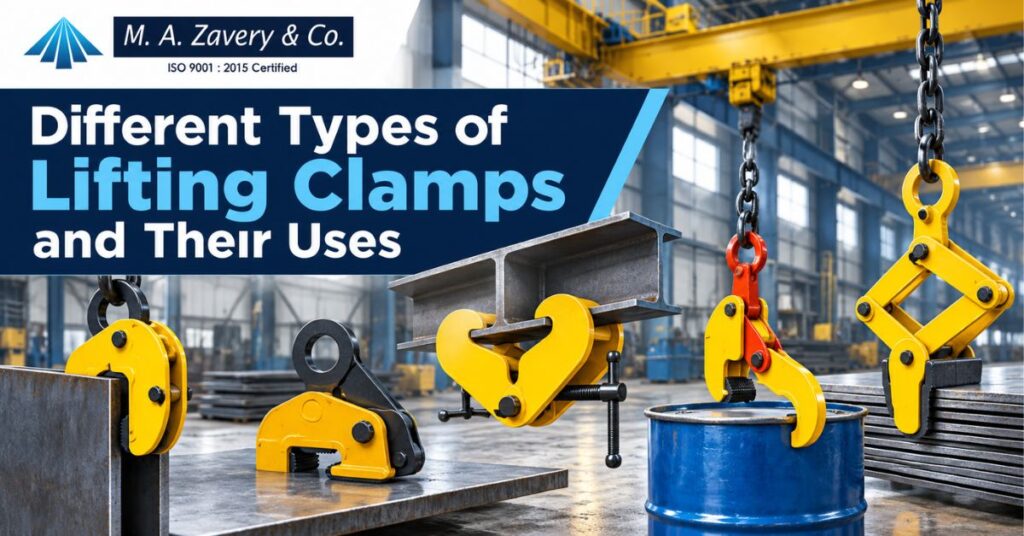
Choose the wrong clamp, and the load tells you fast. A plate slides, a beam tips, or a pipe rolls out of the jaws. Pick the right one, and the lift feels dull – exactly what you want. So let’s look at how each clamp style works, where it fits, and how to choose. Short answer: six main types of lifting clamps. Vertical plate clamps – lift and rotate steel plate from flat to vertical. Horizontal plate clamps. Used in pairs to hold the plate flat. Beam and girder clamps are used to grip a beam flange to lift or hang equipment. Pipe and round stock clamps – these hold round loads that want to roll. Rail clamps: select single rails or bundles of rails. Screw clamps: adjustable, controlled grip, threaded pad. That’s what they’re there for. What Is a Lifting Clamp? A lifting clamp is a grip-type device below the hook. It attaches mechanically to a plate, beam flange, or pipe wall to create a lifting point. You attach it, hook it up to a hoist or crane, and lift it sans drilled holes or welded lugs. Most clamps hold objects in two basic ways. Cam clamps have a cam that is spring-loaded, and that bites harder as the tension increases. Screw clamps use a threaded pad which the operator tightens by hand. One supplier says the cam clamps force-hardened steel teeth into the plate when the load pulls on them. Most vertical plate clamps use a cam, which provides a clamping force that increases with the load, hoist industry writers add. ASME B30.20 is the safety rule for below-the-hook lifting devices. Each clamp is rated by the manufacturer for a specific orientation. Always check that rating first thing. Types of Lifting Clamps at a Glance Clamp type Grips Orientation Typical use Vertical plate clamp Plate edge Lifts plate upright or turns it Fabrication, shipyards, loading, cutting tables Horizontal plate clamp Plate edge, flat Keeps plate flat Stacking, moving plates, loading presses and shears Beam or girder clamp Beam flange Vertical or horizontal Lifting I-beams, stacking girders, hanging hoists Pipe or round stock clamp Cylinder surface Varies Pipe yards, bar stock handling Rail clamp Railhead Horizontal bundles Rail yards, track work Screw clamp Any gripped edge Varies Positioning and controlled grip Plate Lifting Clamps The largest family is that of the sheet and plate clamps. Industry guides divide them into two basic types: horizontal and vertical plate clamps. Vertical Plate Clamps A vertical plate clamp grips the edge of the plate and lifts it upright. These are the most common clamps in plate shops. A spring-loaded cam bites into the face of the plate, and most designs have a safety latch that locks the clamp once it’s engaged. Fabricators use them to turn plates from flat to upright, load plates onto cutting tables, and load trucks. One supplier offers models with turning up to 180 degrees. There are two rules: A vertical clamp lifts one plate at a time. Do not use it to move a plate sideways. The clamp can be damaged, and the load dropped if a vertical clamp is used for a horizontal pull. Horizontal Plate Clamps Vertical clamps slide over the edge of the plate and hold it flat. Industry writers say horizontal clamps are only for plates laid flat. Usually used in pairs, connected by a two-leg sling or a lifting beam. Long plates may take more than one pair. A good example is Camlok THS. It is designed for horizontal plate handling. The THS suits loading plates into presses, shears and guillotines, and can work alone for short plates, say, makers. If two are used, the sling angle from the vertical shall not exceed 30 degrees. A spring-loaded safety lock keeps it closed on the plate ahead of the lift. Camlok cautions against using it on stainless steel, lead, or copper and requires a maximum plate hardness of 300 Brinell. Multi-Directional Plate Clamps Some clamps cover both orientations. They have two suspension holes, one for vertical and one for horizontal lift. They are great for shops that do a lot of different things with plates and want fewer clamps on the rack. Beam and Girder Clamps Beam clamps wrap their jaws around a flange of the beam. The jaw shape is different from a plate clamp, as the clamp body needs to maintain the beam in its intended orientation during the lift. Not all beam clamps lift vertically and should never take a side load. Special version of Camlok TTR girder stacker clamps. The TTR carries girders in the H position and keeps them almost horizontal, making it easier to place them into saw vices, punches, and storage stacks. An offset suspension lug sets the balance point, and the clamp is secured to the vertical flange with a jaw locking lever. For short girders, use one clamp. For longer ones, use a pair with a spreader beam. The maker quotes a design factor of 4:1 and a working load limit from 50 to 3,000 kg across the range. See the product page for the model you need. Its main users are steel stockholders and fabricators. A beam clamp has another use: it provides a quick suspension point for a hoist. In this role, ensure that the clamp rating includes the hoist and the load. Pipe and Round Stock Clamps Rolling loads are risky because they roll. Pipe clamps have either a scissor action or curved jaws to grip the pipe. They also have a rear tube and round bar. Camlok TRU round stock grabs are good for this job. The manufacturer says the TRU can handle round stock and pipe up to 600 mm in diameter with a working load limit of 100 to 4,000 kg depending on the model. Optional protective lining allows it to handle easily scratched surfaces. When applying the lining, all surfaces must be dry, clean, and free of oil and grease. The maker also points out that
Difference Between Chain Hoist and Chain Block
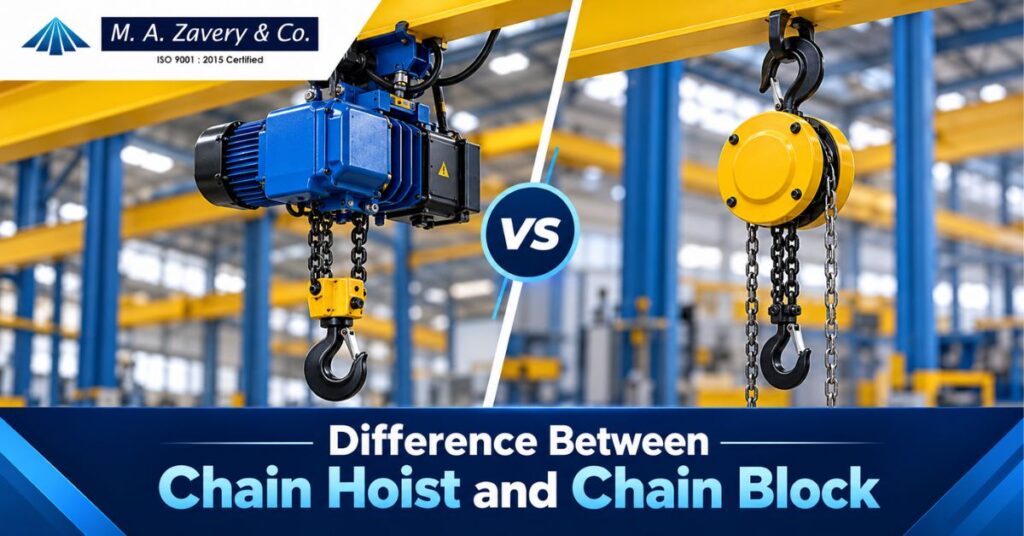
Ask five people on a shop floor, and you might get five answers. “A chain block and a chain hoist,” it is said, “are the same machine. And one says he is manual and one is electric. A third says it’s the type of lever, too. They are all partly right. Let’s break it down so you don’t have to make a second phone call for the right gear. Quick response: A chain block is a hand-operated hoist. It has a hand chain to lift or lower a load. Chain hoist is the larger family. This includes hand chain hoists (chain blocks), lever hoists, electric chain hoists, and pneumatic chain hoists. So all chain blocks are chain hoists, but not all chain hoists are chain blocks. This is why the names overlap and how to choose. What Is a Chain Block? A chain block is a manual hoist for vertical lifting of loads. The machine is suspended from a fixed point, e.g., a beam clamp or trolley. One side has a hand chain, and the other has a load chain running through the body to a bottom hook. That’s how it works. You pull the hand chain down. This causes the gears inside the unit to turn, which then moves the load chain to lift or lower the load. One retailer describes the setup as a static top hook for suspension and a load hook at the bottom, moved by pulling the hand chain. Another source describes the interior as a combination of geared pulleys fitted with a chain. Capacity varies by model. One industry source cites typical hand chain hoist ratings from a quarter tonne to 50 tonnes, although most workshop units are well below that top figure. Each approved unit has a rated load, and the maximum permitted shall never be exceeded. Other Names for a Chain Block Not always the same. Same tool name. Industry sources say that a hand chain hoist is also sometimes called a chain block or a chain fall. You may also like these terms: Chain hoist manuals Hand chain hoist Chain Block Pulley Block and tackle (some retailers loosely call it) Columbus McKinnon, a leading hoist maker, uses ‘chain fall’ for the hand-operated type, and its experts say you can use one anywhere you would use an electric hoist, but without the need for power. That makes it a good choice for remote sites and places with intermittent power. What Is a Chain Hoist? The general term is a chain hoist. Any hoist that lifts with a load chain will do. This family comprises: Hand chain hoists (chain blocks): operated by means of a hand chain Lever hoists: operated by a ratchet handle Electric Chain Hoists, Motor Driven, Pendant Control Air chain hoists: driven by compressed air One supplier says the difference between a hand chain hoist and an electric version comes down to how you operate it: Human effort for one, an electrical connection for the other. That’s the simplest split in the category. When people say “chain hoist”, they often mean the electric type and leave out a qualifier. Always ask what kind they mean before you quote or order. Chain Hoist vs Chain Block: Side-by-Side Comparison Here is how the terms line up in daily use. Feature Chain Block Chain Hoist (broad term) Meaning Hand-operated hoist Any hoist that uses a load chain Power source Your muscle, via the hand chain Hand, lever, electric motor, or air Lift direction Vertical only Depends on type Speed Slow, steady Fast with electric or air Power needed None None for manual, yes for electric and air Typical use Workshops, maintenance, field repairs All of those plus production lines Common confusion Often called a chain fall or manual hoist Often means electric when used alone Why the Names Get Mixed Up A lot of the confusion is explained by regional custom. “Chain block” is common in India, the UK, and Australia. In the US, “chain hoist” is more common. The term “chain hoist” is used everywhere, sometimes for manual units, sometimes for electric ones. Product listings also get mixed in. Here is how the labels change on the M.A.Zavery website. It lists the Elephant H-100 Series as a chain block, the Elephant C21 Series and Super 100 as manual hoists, and the Beta Series as an electric chain hoist. Same family category. 3 labels. If you are unsure, read the product description, not just the title. Chain Block vs Lever Hoist: Another Common Mix-Up People also interchange “chain block” and “lever hoist”. They look the same, but they work differently. An overhead hoist is a chain block which lifts vertically. You pull the hand chain, and it never needs a lever. One UK supplier calls it the perfect answer for repetitive vertical lifting from a fixed overhead point. A lever hoist has a short handle you crank up and down to engage a ratchet and pawl. This design allows it to lift, pull, and tension loads at different angles. The lever block operates by turning the handle. This moves the load a set distance per stroke. Lever hoist working load limits range from 250 kg to 9 tonnes according to supplier guides. A lever hoist is also suitable for lashing and tightening jobs. Here’s a fast guide: Chain block: Lifting a machine vertically off a beam Lever hoist pulling together steel beams Chain block for daily lifting at one post Lever hoist: Tightening a rope or chain Lever hoist: tight spaces where a hand chain has no room Hand chain hoists must be used for vertical lifting only. Use a lever hoist for angled pulls. As an example, the Elephant YA Series lever hoist is listed on the M.A.Zavery site. The two types have different ASME standards too. ASME B30.16 covers hand chain-operated chain hoists and electric and air hoists, and lever hoists have their own volume, B30.21. Chain Block vs Electric Chain Hoist This is the comparison that matters when you
Elephant Hoists for Construction Sites: Which Series Works Best
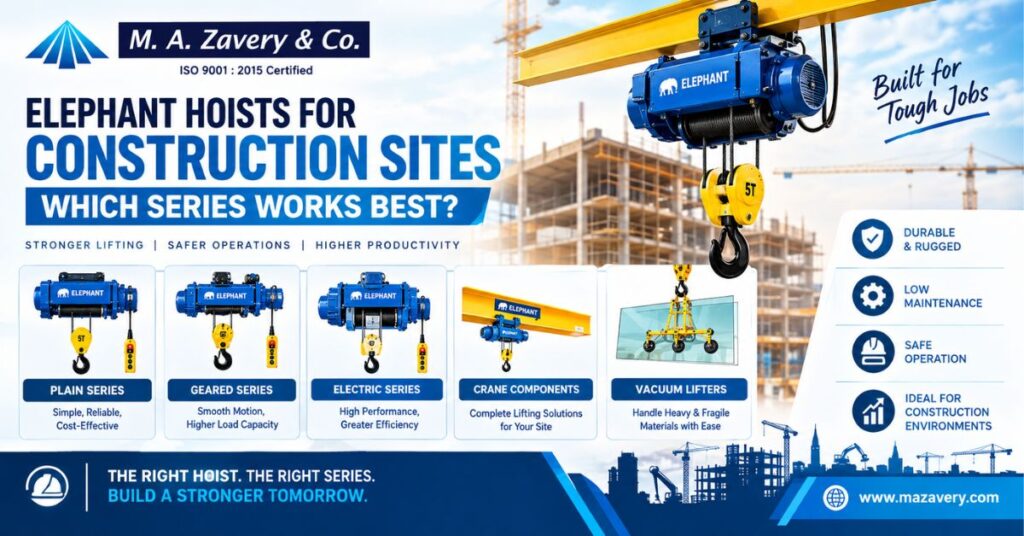
A construction site seldom enjoys the luxury of a fixed power supply, a clean workshop floor, or a predictable lifting schedule. One day you’re putting up steel beams, the next you’re tensioning a cable at an angle where no straight chain block will work, and the day after that you’re moving heavy formwork on a schedule that doesn’t allow for any equipment that slows down the crew. That’s what makes choosing the right hoist for a construction site different than choosing one for a factory floor. This guide runs through the Elephant Hoist series, most appropriate to site conditions and how to match each of them to the kind of lifting your project really needs. What Construction Sites Need from a Hoist Before we compare series, it helps to identify what makes construction lifting different than a fixed industrial setting. Power is not always there. Most lifts are done before a site has permanent electrical service, or in areas of the site a temporary generator has not yet reached. Loads are moving at odd angles. Tensioning cables, aligning formwork, or pulling a load sideways into place does not always equal a straight vertical lift. Equipment is constantly on the move. A hoist that is easy to carry up and down floors or across work zones will save real time over a shift. Things are more difficult. Dust, moisture, and temperature swings are par for the course on an active site, and equipment has to be able to take that without special treatment. Crews switch lifting tasks often. You might have the same crew doing chain lifting in the morning and a cable tensioning job in the afternoon. So it matters to have the right hoist type on hand for the job. With those needs in mind, here’s how the Elephant range stacks up against real construction tasks. C21 Series: The Go-To for General Site Lifting The C21 Series manual chain hoist is the go-to workhorse for construction sites without a power source at the lift point. It’s a hand-operated chain block, so it works wherever a worker can stand and pull a chain. No generator, no extension cords, no waiting on the electrical contractor to finish rough-in. For a site crew, the attraction is straightforward. The C21 is compact and lightweight for the rated capacity, important when it has to move between floors or work areas multiple times a day. It includes a galvanised load chain and a mechanical brake that holds a load at height when the operator stops pulling. Just what you want when positioning a beam, a duct section or a piece of formwork that needs to stay put while it is fastened into place. This series is good for general lifting – getting materials into place during construction, lifting equipment during installation, and any job where the lift is straight up and down and doesn’t need to happen dozens of times an hour. H100 Series: For Heavier Loads and Frequent Cycles When a site gets into the heavier structural work, the H100 Series takes over from the C21 in build quality without losing the advantage of manual, power-free operation. It has bearing-supported shafts to keep hand-chain pull effort manageable even at full rated load and a double brake pawl system for added holding security on heavier lifts. This is very important on sites where the same lift is repeated often during a shift, the installation of structural steel, placement of precast panels, or placement of mechanical equipment, where operator fatigue is a real factor if the hoist requires too much pull effort per cycle. The H100 is built to withstand that repetition without the wear problems that a lighter-duty hoist would experience under the same usage. YA Series and Y2 Series Lever Hoists: For Angled and Tensioning Work Not all construction lifts are straight-up pulls. The YA Series and Y2 Series find their place on the job site when tensioning a guy wire rope, pulling a beam into alignment, or securing a load at an angle instead of a chain block. A lever hoist uses a ratchet lever rather than a hand stacker loop, meaning that the hoist can be used in any orientation – horizontal, angled, or upside down – without loss of control of the load. That flexibility is always on display on a construction site: rigging steel to alignment before final bolting, tensioning cables during formwork bracing, or pulling equipment into position along a surface rather than lifting it away from the ground. The YA Series features general rigging and tensioning with single-action free spooling that lets a worker quickly pull slack chain through before engaging the lever, saving setup time on repetitive rigging jobs. The Y2 Series increases the load capacity for heavier tensioning and positioning work. Both have a reinforced load chain built to withstand the side loading that occurs with angled pulls, which a straight chain block is not designed for. Alpha and Beta Series Electric Hoists: For Sites with Power and High Lift Volume Once a site has stable power, whether it’s permanent service or a well-placed generator, and the lifting volume justifies it, the Alpha Series and Beta Series electric chain hoists take over from manual operation. They can run on single-phase or three-phase power with variable or constant speed options. These hook-suspension hoists eliminate the physical effort and time cost of manual lifting. This is most useful on a construction site for projects with a large volume of repetitive lifts through a fixed point, material handling equipment hoisting on a multi-storey build, repeated equipment placement during a mechanical fit-out, or any task where the same lift happens dozens of times a day. The labour savings of converting a high-frequency manual lift to an electric type are usually apparent within the first few weeks of a demanding schedule. SA, FA/FB, and DA/DB Series: For Heavy-Duty and Continuous Site Work When working on larger construction projects such as industrial builds, bridge work, or heavy structural steel jobs, the
Genuine Elephant Hoist Parts & Spares in India: Where to Buy
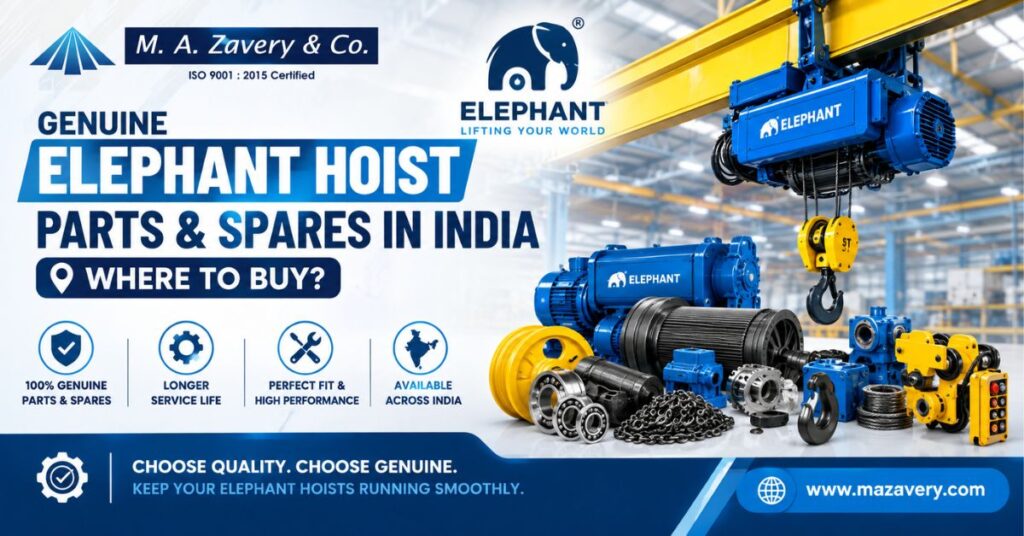
A hoist working for years does not break all at one time. It is usually one part – a worn brake lining, a stretched load chain, or a cracked hook latch – that finally gives out. When that happens, the part you replace it with is as important as the hoist itself. A real elephant part keeps the hoist going at rated capacity. A mismatched or counterfeit part can quietly turn a reliable piece of equipment into a safety hazard. This guide talks about the common spare parts that keep an Elephant hoist running, why it’s important to source genuine components, and how to find a supplier in India you can trust with the job. Why Genuine Parts Matter for an Elephant Hoist Every part in a chain hoist or lever hoist functions as part of a system, not in isolation. The load chain, gears, brake pawls, and housing are all manufactured to specific tolerances according to the hoist’s rated working load. Change a chain from another manufacturer, or a brake part that looks the same but isn’t rated the same, and you change the way the whole system behaves under load. The danger is not always immediately apparent. A mismatched part in a hoist may work fine for weeks until the weak link finally breaks, usually under a heavier load or a longer shift than normal. This is the sort of failure that inspection schedules and load testing are meant to catch, but they only work if the parts inside the hoist are what the manufacturer specified in the first place. Common Spare Parts for Elephant Hoists Here is a list of the parts that most commonly need replacing during the working life of a hoist. Load Chains The load chain is the part that actually does the lifting, so it gets the most wear. Elephant hoists use galvanised or zinc-plated load chains that are graded to hold the rated capacity of the hoist with a safety margin built in. Chains can stretch over time, links can thin out at the pivot points, and surface corrosion can begin to form in humid or outdoor environments. A chain that is stretched or worn should be replaced before it becomes a failure point, not after. Hooks and Safety Latches The suspension hook and the load hook are both subject to repeated stress cycles. Elephant hooks are designed to distort rather than break if ever overloaded, thus giving a visible warning before catastrophic failure. Hooks have safety latches. These latches wear out from opening and closing and need to be replaced regularly to maintain a secure capture of the load during a lift. Brake Pawls and Braking Components When the operator stops pulling the hand stacker or releases the lever, the braking system holds the load steady at height. Elephant’s H100 series is fitted with a double brake pawl system, while the YA and Y2 lever hoists have a self-locking brake mechanism. These parts are subject to wear from friction after thousands of cycles, and a worn brake pawl is one of the more serious failure points in a manual hoist, since it directly controls whether a suspended load stays where you put it. Hand Chains and Gears The hand chain and the guide wheel for it are constantly handled, and the internal gear train for reducing effort on a geared or lever hoist can wear at the tooth contact points after years of heavy use. Changing out a worn hand chain or gear set will bring back the low-effort operation the hoist was designed for. Electric Motor and Control Components The elephant’s electric chain hoists of the Alpha, Beta, SA, FA/FB and DA/DB series have spare parts for the hoisting motor, pendant controllers, push button stations and limit switches. Electrical parts wear differently than mechanical wear parts. Often, when the insulation wears through, contact wear occurs in the push buttons, or the cable is damaged and needs replacement with properly rated parts so that the hoist’s speed, duty cycle, and safety cutoffs work as designed. Wheels and Bearings for Trolleys The trolley wheels and shielded ball bearings of your Elephant hoist may wear out because of the constant rolling contact with the beam flange, whether your hoist has a plain, geared, or electric trolley. The wheels get worn and cause uneven travel and extra stress on the beam and gear mechanism of a geared trolley. The Risk of Counterfeit or Mismatched Parts There is a fair share of grey-market and counterfeit parts in the industrial equipment market in India sold as compatible replacements for genuine brand components. The parts look almost like the real thing, and the price difference is what makes them tempting. The problem is in the details you can’t see from the outside. The forged load chain may be made from a lower grade of steel than the rating stamped on it indicates. A generic brake pawl may not last as long as the original part under the same friction cycles. And none of this is obvious in a quick visual inspection, and often it doesn’t show up in normal operation either, right up until the moment the part is pushed beyond what it can actually handle. That guesswork is gone by buying authentic parts from an authorised supplier. Authorised distributors pull their stock directly from the manufacturer’s supply chain, so the chain grading, brake material handling equipment and electrical ratings are all the same as what the original equipment was built with. How to Identify a Genuine Part A few checks help you make sure you are getting the real deal before you put a replacement part into your vehicle. Purchase from an authorised distributor. A supplier with a long-standing, established relationship with the Elephant brand is far less likely to be selling grey-market stock. Look for manufacturer’s markings. Real load chains and hooks have a grade stamping and manufacturer identification that counterfeit parts often leave off or copy incorrectly. Request model and part number to
Types of Products Offered by Elephant Brand Hoists

If you have ever spent time in India near a workshop, warehouse, or fabrication yard, you may have heard the name Elephant. It’s a brand that you keep seeing on shop floors because the equipment can stand up to daily use. But “Elephant hoists” are not just one product. A full line-up, covering hand lifting, lever operation, and electric power, all built for a different kind of job. Learn about the complete line of Elephant brand hoists, what each series is designed to do, and how to determine which one is right for your application. Let us take it by series. A Quick Background on the Elephant Brand Elephant is a Japanese manufacturer of lifting equipment known in the industry for its very close attention to build tolerances and durable construction. The company has established a reputation for chain blocks, lever hoists and electric chain hoists that have retained their rated capacity after many years of repeated use, even in rough industrial environments such as foundries, steel yards and construction sites. M.A. Zavery & Co. has been supplying genuine elephant hoists in India since 1983, acquiring stock through authorised channels and backing every purchase with technical guidance regarding capacity and configuration. That long track record counts, because counterfeit or grey-market hoists often skip the load chain grading and braking systems that make the real deal safe to use. Manual Chain Hoists: C21 Series and H100 Series Manual chain hoists are often the first choice for most lifting jobs where power is not available or loads do not need to be lifted frequently. You pull on a hand chain, and the hoist lifts or lowers the load through a gear-reduced mechanism. The C21 Series is a compact hand-operated chain block suitable for maintenance work, workshop lifting and general light to medium industrial use. The hoist has a galvanised load chain, compact housing and a mechanical brake system that locks the load in place at any height when you stop pulling. These lightweight hoists are easy to move between job sites or around a shop floor because of their capacity. The H100 Series is the benchmark for build quality for more demanding, more frequent lifts. Features bearing-supported shafts for low hand-chain pull effort at full rated load and a double brake pawl system for additional holding security. Both ranges have safety latches on the hooks, and the load hook should fail under overload, not snap, so that operators have a visible warning sign before a failure point is reached. The C21 and H100 hoists also come with either plain or geared trolleys if you want to move the load horizontally along a beam and not just vertically. Lever Hoists: YA Series and Y2 Series A lever hoist operates in a different way to a chain block. Instead of pulling a hand chain through a loop, you move a ratchet lever back and forth. This makes them perfect for angled pulls, horizontal pulling, or tensioning work where a chain block’s straight vertical pull isn’t going to do the job. Elephant’s standard lever hoist line, the YA Series, is built for general rigging, tensioning, and positioning applications in construction, pipeline work, and machine installation. It has single-action free spooling, which allows you to quickly pull the slack chain through before engaging the lever mechanism, saving time during setup. The Y2 Series (along with the closely related Y3 Series) completes the lever hoist range with additional capacity options, providing a wider choice to meet varying load and application needs. Typically, lever hoists in this range have a reinforced load chain and a multiple safety factor in the chain, hooks, and braking parts. That is why they stand up to the kind of side load and repeated tensioning that a straight chain block is not designed for. Electric Chain Hoists: Alpha, Beta, SA, FA/FB, and DA/DB Series When your lifting volume is increasing, or the loads are heavy enough to slow production with manual operation, it’s time for electric chain hoists. The Elephant electric range includes single-phase and three-phase power, with options for variable speed or constant speed depending on the series. Alpha Series: Electric hoist with hook suspension, variable and constant speed designs, suitable for general manufacturing and assembly line lifting. Beta Series: Like the Alpha Series in style, but offering single-phase electric operation for facilities needing dependable repeat lifting cycles without the benefit of three-phase power infrastructure. SA Series Hoists for more demanding electric lifting. Available in plain, geared, or electric trolley configurations to meet your load’s travel needs. FA/FB Series: A three-phase electric hoist line for continuous duty applications in manufacturing plants and heavier warehousing operations. DA/DB Series – The higher capacity end of the electric range, designed for heavy-duty lifting where load volume and cycle frequency are high. Any of these electric series may be coupled with plain, geared, or electric trolleys. They are equipped with a hook-suspension that allows an easy installation on an existing beam. If your shop has long shifts with the same load pattern repeated dozens of times a day, the labour savings of an electric hoist will generally pay for the equipment in a reasonable time. Trolleys: Plain, Geared, and Electric A hoist can lift a load up and down, but it cannot move that load side to side by itself. That’s where a tram comes in. The elephant provides a full range of trolleys in both washer and standard type builds, designed to fit directly with the manual, lever and electric hoist series above. A simple trolley has no gears and is pushed by hand. They work well for light loads where only occasional horizontal movement is needed. Geared trolleys use a hand chain and reduction gears to give the operator more control and less physical effort when moving heavier loads or positioning them accurately. Electric trolleys are motor-driven and compatible with the electric hoist series and are ideal for high-frequency lifting, long beam runs, or heavy tonnage that would slow the job down with
How to Choose the Right Elephant Trolley (Plain Vs Geared Vs Electric)
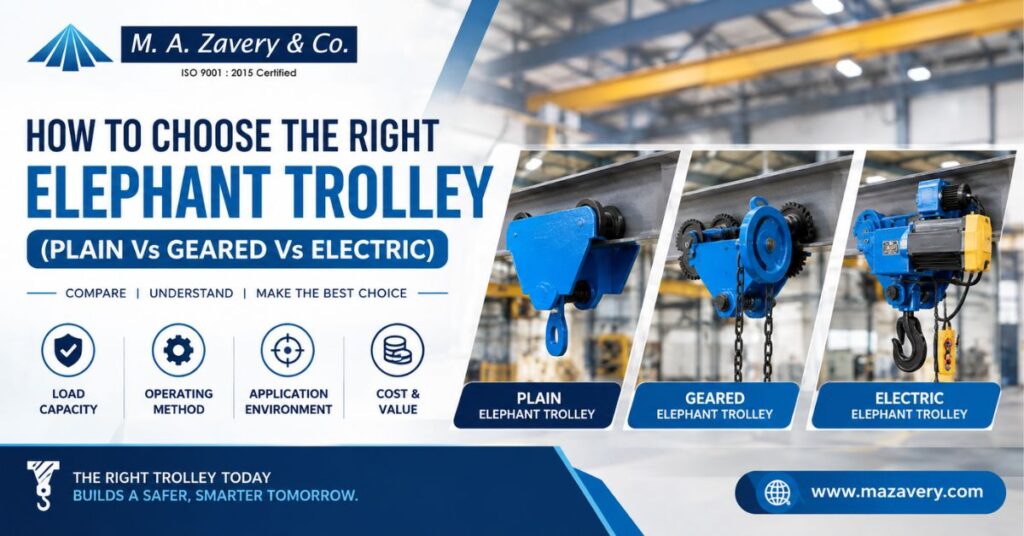
If you run a workshop, warehouse, or fabrication yard, you’ll already know that a hoist alone can’t move a load sideways. And that’s where a tram comes in. It runs on the bottom flange of an I-beam or H-beam and carries the hoist and its load the length of the beam. Choose the wrong one, and you’re paying for features you don’t need – or slowing down your team every single shift. This guide explains the three main types of trolley used with Elephant brand hoists: plain, geared and electric. When you’re finished, you’ll know which one suits your load, your beam and your budget. What Is a Beam Trolley and Why It Matters The Elephant range beam trolleys are wheeled carriages that run on a beam flange and carry a chain hoist or lever hoist. It has two side plates, a set of flanged wheels, and a suspension shaft from which the hoist is hung. The tram does one thing. It lets you move a suspended load horizontally without lifting it off the beam or lugging it around by hand. A plain, geared or electric trolley – which one you need depends on three factors: how heavy your loads are, how often you move them and how accurately you need to position them. Get the match right and your team will spend less time wrestling with equipment and more time getting work done. The Three Main Types of Trolleys in the Elephant Range Plain Trolley (Push Type) A plain trolley (or push trolley) operates when an operator manually pushes the load along the beam. There’s no gearing and no chain mechanism. You get hold of the hoist or the load, and you walk it down the rail. This design is good for light to moderate loads that do not have far to travel. A maintenance technician who has to shift a 500 kg gearbox across a workshop bay several times a day doesn’t need anything more complicated. The plain trolleys are also the lightest and cheapest of the Elephant range and require little maintenance other than checking wheels and bearings from time to time. The trade-off becomes obvious as loads get heavier or beams get longer. Trying to push a one-tonne load with your hands gets tiring quickly, and stopping it exactly where you want takes practice. Geared Trolley (Hand Chain Type) A geared trolley has a reduction gear set and a hand chain. Like a hand chain hoist lifts a load. The operator pulls on a loop of chain rather than pushes. The gearing multiplies the effort and reduces the speed of travel of the tram. This setup gives you two real benefits. First, it decreases the physical effort when moving heavier loads, since the gear ratio does most of the work. Second, it gives you a lot more position control. If you are positioning a machine part with a fixture or lowering a load into a tight assembly slot, that fine control is more important than raw speed. Geared trolleys are ideal for medium to heavy loads, longer travel distances, and jobs where accuracy is more important than speed. They cost more than a simple trolley but less than electric trolleys, making them a popular middle-ground option on Indian shop floors. Electric Trolley (Motorised Type) An electric trolley replaces the hand’s effort with a motor. You push a button, and the hoist and load move along the beam at a set speed. The Electric Trolleys from Elephant work with single-phase and three-phase electric hoists like the Alpha, Beta, SA, FA/FB and DA/DB series and generally provide variable or constant travel speeds depending on the model. This is the right call for high-frequency lift, long beam runs, or heavy tonnage where manual travel would slow productivity.” The electric trolley is most valuable on assembly lines, continuous warehousing operations and manufacturing plants that move the same load pattern dozens of times a day. You will have a higher initial cost and will need a power supply at the point of use, but the labour savings and consistent cycle times often make up for it over the life of the equipment. Plain vs Geared vs Electric Trolley: Quick Comparison Below is a quick side-by-side to help you scan the differences. Plain Trolley: Manual push operation, lowest cost, best for light loads and short, occasional moves. Geared trolley. Hand chain operated. Moderate cost. Best for medium to heavy loads. Precise positioning. Electric Trolley: Motorised operation, highest cost, best for heavy loads, long travel and repetitive high-volume lifting. If your team moves loads under a tonne only a few times a shift, begin with a plain trolley. If you’re moving loads over a tonne or require precise positioning, go for a geared trolley. If you run a production line that does the same lift dozens of times a day, an electric trolley pays for itself in labour savings. How to Choose the Right Trolley for Your Application So let’s make this a simple decision process that you can go through before you buy. Check load weight. Match the rated trolley capacity to your heaviest expected load, not your average load. Never buy right at the limits. Measure the width of your beam flange. Trolleys come with a variety of flange widths. Before ordering, make sure your I-beam or H-beam size is in that range. Count your lifts per day. A couple of moves a day means a simple tram. Dozens of moves a day suggest a geared or electric trolley. Think of the distance to travel. Better for short runs are plain and geared trolleys. Long beam runs are well adapted to electric trolleys because operators tire quickly when running by hand over distance. Think about the accuracy needs. If you’re loading into fixtures, moulds or tight assembly points, a geared or electric trolley with controlled speed gives you better accuracy than a plain push trolley. Adjust it to your hoist. Your trolley must match your hoist model, be it
How Much Weight Can Elephant Lifting Equipment Lift?
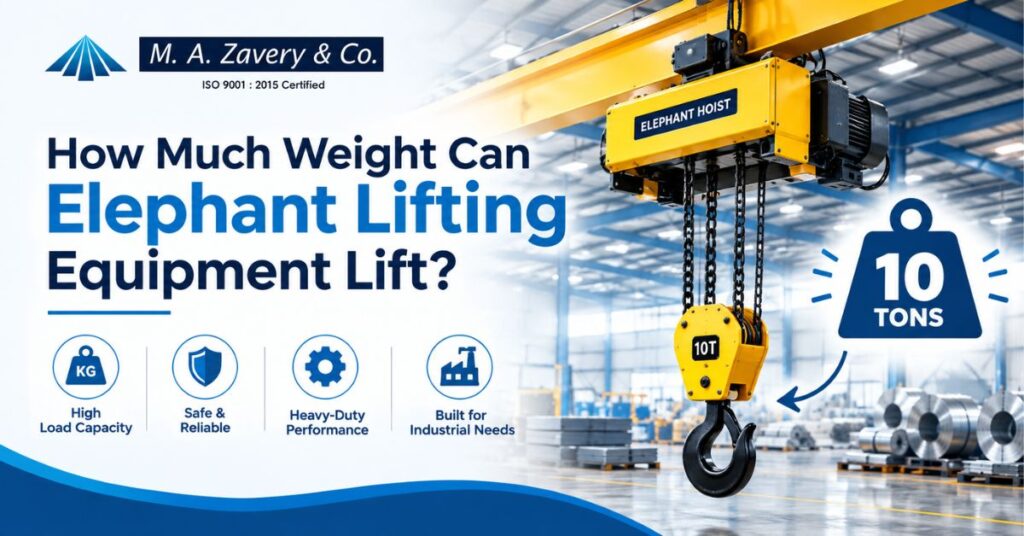
If you have worked with hoists on a factory floor, construction site, or shipyard, you are probably familiar with the Elephant name. It is one of the better-known names in the chain hoist business, appearing on manual hand chain hoists, electric hoists, and trolleys in dozens of industries. But the question most buyers ask before they order is simple: how much weight can elephant lifting equipment lift? The short answer is dependent on the model. Elephant lifting equipment ranges from small hand chain hoists rated at a few hundred kilograms to large industrial hoists rated well past 30 tonnes. This guide breaks down the actual capacity ranges by product type, explains what decides those numbers, and covers how to pick the right one for your job. Let’s take them one by one. What Is Elephant Lifting Equipment? Elephant is a brand of hoists and rigging, including manual chain hoists, electric chain hoists, air (pneumatic) hoists, lever hoists, and the trolleys and beam clamps that run on a rail to carry them. It covers everything from light manual lifting in a small workshop to heavy-duty electric hoisting in a shipyard or steel plant. Elephant’s range includes the C-21 manual chain hoist, the Super 100 series, three-phase and single-phase electric hoist ranges, and matching trolley systems. How Much Weight Can Elephant Lifting Equipment Lift? Capacity is entirely dependent on which product line you select. Based on published manufacturer and distributor specifications, here is the general range across the main categories. Hand Chain Hoists Any line of Elephant products includes the widest range of manual hand chain hoists. (Source: “Hoists, Comealongs, Winches, Beam Crawls”, Elephant Lifting Products, https://elephantlifting.com/) A typical C-21 hand chain hoist starts at about 1 tonne and goes up to 5 tonnes for common workshop and construction applications. Heavy-duty versions of the hand chain hoist range goes much further, with high-capacity models rated between 16 and 50 tonnes for large industrial lifts (Source: “Elephant High Capacity Hand Chain Hoist, 16 Tonne to 50 Tonne”, Ergonomic Partners, https://www.ergonomicpartners.com/high-capacity-hand-chain-hoists). The full hand chain hoist catalogue includes capacities from 1.6 tonnes to 50 tonnes and will meet almost all manual lifting jobs on a site (Source: “Elephant Hoists, Elephant Lifting Systems”, Chainhoist.com, https://chainhoist.com/brands/elephant/). Electric Chain Hoists Electric hoists give up a little of that top-end capacity for speed and less physical strain on the operator. The Elephant DA-3 is a common model rated at 3 tonnes with lift heights of 10, 15, or 20 feet and powered by a single-speed 230V or 460V three-phase motor (Source: “Elephant DA-3 Electric Chain Hoists For Sale”, Hof Equipment Co, https://hofequipment.com/elephant-da-3-electric-chain-hoists-p2436.html). The standard capacities of the broader electric hoist range typically vary from a quarter of a tonne to 5 tonnes for everyday industrial use (Source: “Elephant Hoists, Elephant Lifting Systems”, Chainhoist.com). Large-capacity electric chain hoist models push that range up significantly for heavier jobs, with some series rated from 100 kilograms all the way up to 30 tonnes, and select large-capacity units designed to carry loads up to 30 tonnes all on their own (Source: “Large Capacity Electric Chain Hoists, 10t to 50 Tonne Capacity”, Elephant Lifting, https://elephantlifting.com/product/electric-chain-hoists/large-capacity-electric-chain-hoist/; “Hoists, Comealongs, Winches, Beam Crawls”, Elephant Lifting Products). Air (Pneumatic) Chain Hoists Air hoists are faster than manual hoists but slower than electric hoists and are suitable for hazardous areas where sparking from electrical equipment may be a problem. Standard catalogue (Source: “Elephant Hoists, Elephant Lifting Systems”, Chainhoist.com): Elephant hoists are available from a quarter tonne to 10 tonnes. This makes air hoists a good choice for petrochemical plants, paint booths, and other environments where combustible dust or vapour rules out electric motors in the vicinity. Trolleys and Support Equipment Hoists rarely work in isolation. Push, geared and electric trolleys carry the hoist along an I-beam or monorail, and their own rated capacity has to equal or exceed the hoist mounted on them. Beam clamps and plate lifters round out the range, allowing the same hoist to attach to different beam widths or grab flat steel plate directly. None of these provide any additional lifting capacity above the rating of the hoist attached to them. The whole system, the hoist, trolley, and rigging, is only as strong as its weakest rated component. What Decides the Lifting Capacity of a Hoist? The maximum weight any hoist, elephant or otherwise, can safely lift is limited by a few design factors. Gear ratio and chain type. The mechanical limit on rated capacity is determined by the grade of the load chain (usually Grade 105 galvanised chain on Elephant models) and the reduction gearing inside a manual hoist. Motor power: For electric hoists, motor output, lift speed, and top rated capacity are all connected. Hook and frame strength. The steel frame, hooks, and load sheave all have to be strong enough to match the chain rating; otherwise they become the actual weak point, not the chain. Class duty. Hoists intended for continuous or frequent lifting (higher duty ratings) often have different practical limits than a hoist intended for occasional, light-duty use, even at the same nominal capacity. Lift height and reeving: Longer lift heights and multi-fall reeving (where the chain runs through extra sheaves) change the load distribution across the chain, and this is accounted for when calculating the rated capacity for that config. Safety Margins and Load Testing Standards Rated capacity on the nameplate is never a number to strive for. Reputable chain hoist manufacturers build in a safety margin and test each unit well beyond its rated load before it ships. For instance, Elephant electric chain hoists are made to conform to ASME B30.16, the American standard for overhead hoists, and each unit is load tested to 125 per cent of its rated capacity before leaving the factory (Source: “Elephant DA-3 Electric Chain Hoists For Sale”, Hof Equipment Co). That margin is there to allow for shock loading, wear and tear over time, and small variations in how a load is rigged, not to allow operators to exceed the
10 Factors Affecting Selection of Material Handling Equipments
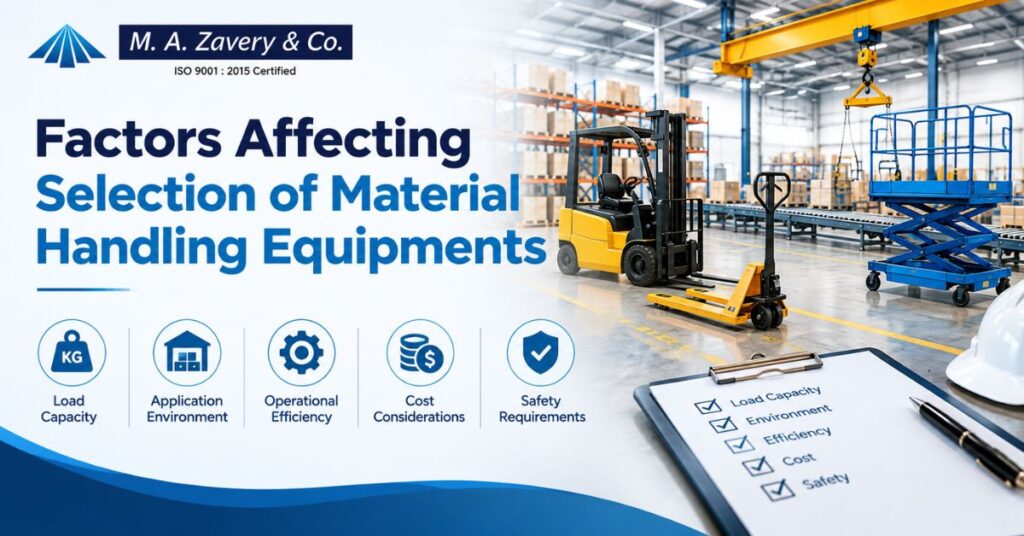
Choosing the right machine to move goods around a warehouse, workshop, or construction site is not a guess. It affects worker safety, daily production, and costs years after the purchase order is signed. A hoist rated too low will be overworked. A trolley picked without regard to the floor space will jam up the very aisle it was meant to clear. This guide discusses the 10 factors that influence the selection of material handling equipment, based on established engineering guidance and safety standards. Let’s take it one factor at a time, starting with the load itself and then passing through space, power, safety, and cost. What Counts as Material Handling Equipment? Material handling equipment is any type of machinery used to move, store, lift or control materials during the manufacturing, storage or transportation process. These include manual chain hoists and lever hoists to electric wire rope hoists, pneumatic hoists, winches, cranes, trolleys and rigging gear, including slings, shackles and lifting clamps. Some jobs require a simple hand stacker. Some demand a three-phase electric hoist to be fixed to a monorail. Below are factors to consider for the right fit. Why the Right Choice Matters Getting the wrong decision on this can cost more than the price tag on the machine. Equipment that is too small wears out fast and strains the operator. Large equipment is a drain on space and money. Poor equipment choices increase the likelihood of dropped loads. This is backed up by government data on work injuries: back injuries due to manual lifting make up a significant share of all reported injuries at work in the US, with most of these injuries affecting the lower back (Source: “2025 OSHA Material Handling Guidelines: Lifting, Pushing, Pulling”, Wakefield Equipment, 2025, https://wakefieldequipment.com/osha-material-handling-guidelines/). That fact alone explains why equipment selection deserves serious consideration rather than a quick catalogue pick. 10 Factors Affecting Selection of Material Handling Equipments 1. Properties of the Material Being Moved Don’t catalogue; start with the load. Weight, shape, size, and surface condition all dictate what type of hook, grab, sling, or clamp the job calls for. A smooth steel coil requires different rigging than a rough concrete segment or a hot, greasy part. According to engineering specialists, the weight, dimensions, and surface finish of a load (greasy, hot, or rough) determine the design of the hooks, grabs, or magnets used to lift it. (Source: “How to Select Material Handling Equipment?”, Airpes, 2025, https://www.airpes.com/how-to-select-material-handling-equipment/) “Measure twice,” they say, because getting this wrong at the design stage can lead to serious failures down the line. 2. Load Capacity and Weight Every piece of lifting gear comes with a rated capacity, and that figure should never be viewed as a target to achieve, only a ceiling to stay beneath. Industry advice on this is clear: choose equipment that is strong enough to lift the load with some spare capacity, but not so oversized that it unnecessarily drives operating costs up (Source: “Factors Affecting the Selection of Material Handling Equipment”, LinkedIn Pulse, https://www.linkedin.com/pulse/factors-affecting-selection-material-handling-equipment-namdas-arvind). That’s why rated capacity plates are placed on hoists, trolleys, and slings, and the OSHA rigging rules prohibit this rating from being exceeded. 3. Facility Layout and Available Space The aisle width, the door height, and the overall footprint of the work area all limit what will fit. In a tight ceiling height, a low headroom hoist may be the only realistic option, and a compact electric stacker might be better than a full gantry crane in a narrow storeroom. Training material used across East African logistics bodies also flags the same point. Available floor space, floor condition, and clearance height all shape which equipment can physically go into a site. (Source: “Factors to Consider in Selecting Materials Handling Equipment”, FEAFFA LMS, https://lms.feaffa.com/topic/factors-to-consider-in-selecting-materials-handling-equipment/). 4. Floor and Structural Strength A crane or heavy hoist puts real stress on the floor and structure beneath it, not just the hook. Before ordering equipment, make sure that the floor can support the combined weight of the machine and the load, as well as the stresses of repeated operation over time. Questions to ask ourselves: What is the maximum load that the floor can take? How often can the structure be moved, again and again, without being damaged? Does the building need to be reinforced before installing? 5. Production Flow and Movement Pattern The equipment required is changed by the way goods move through a site. A monorail hoist or conveyor is well suited to a steady, fixed path between two points. A variable flow where loads go to different locations on different days is often better served by a mobile crane, trolley or manual stacker. The right equipment for the right flow pattern means you’re not paying for automation you don’t need or shoving flexible work into fixed ways of working. 6. Speed of Movement Some jobs need a quick turnaround; some do not. The same industry guidance says that the speed at which materials move needs to be kept within the limits of the production process and the safety of workers and not pushed for the sake of speed (Source: “Factors Affecting the Selection of Material Handling Equipment”, LinkedIn Pulse). An electric hoist is quicker than a hand chain hoist, but the advantage of speed is only there if the rest of the process can keep up. 7. Power Source and Level of Automation Manual, electric and pneumatic equipment suit different settings. If there’s no power point nearby and you only need to lift occasionally, a manual chain hoist is fine. Electric hoists can be used for repeated daily lifts where speed and less physical effort are important. Pneumatic (air) hoists are very suitable for hazardous zones with flammable dust or vapour, as they eliminate the risk of electrical sparking. The level of supervision of the task on a day-to-day basis is also affected by the degree of automation of the equipment. 8. Safety and Regulatory Requirements There’s a bloody good reason rigging and lifting equipment is regulated. Under US
Single Phase vs Three Phase Electric Hoist: Key Differences Explained
If you are shopping for an electric hoist, one of the first questions you will run into is whether you need a single-phase unit or a three-phase one. That may seem like a minor detail, but it makes a difference in how the hoist will operate, what kind of power hookups you’ll need at your facility, and even how much the installation will cost you. Let’s analyse it so that you can choose the right one without guessing. What Does “Phase” Actually Mean in an Electric Hoist? All electric hoists use an AC motor, and this motor requires a constant flow of electricity to lift and lower loads evenly. The term “phase” refers to how electricity is delivered. A single-phase supply has one live wire and one neutral wire carrying current. The power goes up and down in a wave. Peaks. Goes back to zero. Goes back up again. A three-phase supply has three separate live wires. Each one carries a current which is offset from the others by a third of a cycle. The three waves overlap, so one is always near its peak, giving the motor a much more even flow of power. From lifting capacity to running cost, this one difference is the reason for nearly every difference between single-phase vs. three-phase electric hoist models. Single-Phase Electric Hoists: What They’re Good At A single-phase electric hoist hooks up to a standard two-wire power supply, the kind you find in a home or small workshop. This is the easier option to install if you don’t already have 3-phase wiring in place. Here’s why people use single-phase hoists: Most of the time they plug into regular electrical outlets, so there is no need for special wiring. Three-phase setups can sometimes require extra wiring and transformer work, and you avoid that, so the installation costs less. They are good for lighter, occasional lifting jobs. They are portable from job to job and small. Where single-phase hoists make sense Single-phase hoists are suitable for small workshops, garages, farms and light fabrication units where loads being lifted are generally under a couple of tonnes and the hoist is not running for hours on end. M.A.Zavery offers Elephant single-phase electric chain hoists such as the Alpha Series and the Beta Series designed for this type of lighter-duty lifting. The tradeoff is that single-phase motors require extra components, such as a capacitor, to get the initial torque moving. This means single-phase hoists tend to have a lower capacity than three-phase hoists and are not a first choice for continuous heavy-duty operation. Three-Phase Electric Hoists: Built for Bigger Loads Instead of one, a three-phase electric hoist has three live wires to power it. Because the current never actually reaches zero at any point in the cycle, the motor receives a steadier, more balanced flow of energy. That translates into real benefits on the shop floor: Motors start and run with less vibration and less heat build-up. The hoist is capable of lifting more weight without drawing excessively on any one wire. Over time, internal parts wear less as the motor is not fighting through power dips. The same wiring can carry more total power without requiring larger cables. Where three-phase hoists make sense Three-phase equipment is more appropriate for factories, steel fabrication yards, warehouses and construction sites that run hoists for long shifts or lift loads over a few tonnes. M.A.Zavery has a three-phase range of elephant chain hoists in the Alpha, Beta and SA Series and wire rope hoists from brands such as Safelift and STAHL that are built for this type of demanding repetitive lift. The downside is that three-phase power isn’t available everywhere. Many homes and small commercial units are single-phase, so you may need to have your electricity supplier run a three-phase line to your location before you can use this type of hoist. Single-Phase vs Three-Phase Electric Hoist: Side-by-Side Comparison Factor Single-Phase Hoist Three-Phase Hoist Power wires 1 live, 1 neutral 3 live wires, offset by 120 degrees Typical lifting capacity Lighter loads Heavier loads Power consistency Fluctuates in a wave pattern Steady, near continuous Installation Simpler, often no special wiring May require new wiring or transformer Best suited for Workshops, garages, light industry Factories, warehouses, construction sites Running cost per lift Slightly higher for heavy use Lower for sustained, heavy use Availability of power supply Widely available Limited in some residential or rural areas Power Supply, Voltage, and Wiring Differences In most parts of India, single-phase supply runs at around 230 volts and three-phase supply runs at around 415 volts between phases. Three-phase motors can move heavier loads without pulling as much current through any one wire. Part of the reason for this is the higher voltage. Single-phase hoists are also easier to wire, as they only require a live and neutral connection similar to a household appliance. Three-phase hoists need three live conductors and, in most configurations, a neutral and an earth wire. This type of hoist will require a three-phase connection, so if you do not already have one in your facility, you will need to contact your local electricity board to arrange one. This adds one more thing to plan for early on, as it can impact your project schedule. Which One Should You Choose? The honest answer really boils down to three things: how much weight you are lifting, how often you are lifting it, and what power supply you already have. Questions to ask before you decide What is the heaviest load you will actually lift regularly? Is the hoist running for a few minutes here and there or hours at a time during a shift? Do you already have a three-phase connection at your site? Is the hoist going to stay in one place, or will you need to move it around? What is your budget for installation, not just the hoist? If you have answers that lead to lighter, occasional lifting, with a standard power connection, a single-phase hoist will do
Manual Hoist vs Electric Hoist: How to Choose the Right One
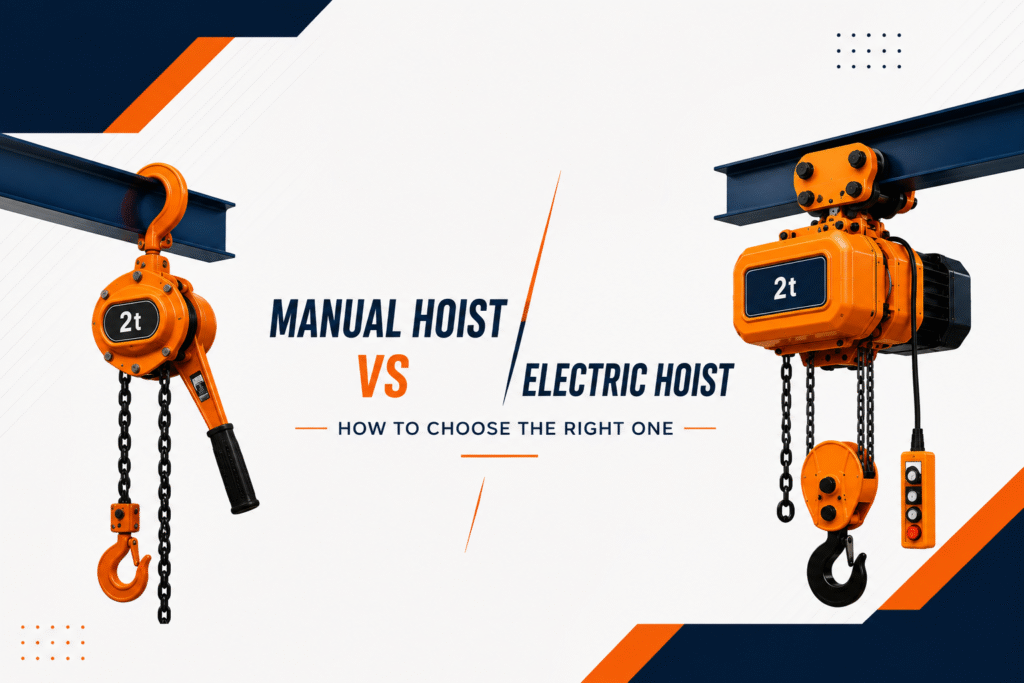
Every lifting job sooner or later comes down to the same question: hand power or motor power? The choice of a manual hoist versus an electric hoist will impact your budget, the speed of your lift, and how often the equipment is used on the floor. Pick the wrong one, and you either overpay for power you rarely use, or you have a hoist that can’t keep pace with your work. This guide describes how each type works, where each one works best, and what to look for before you order. What Is a Manual Hoist? A manual hoist is operated by a man. With a pull on a hand chain or a pump of a lever, gears inside the hoist body multiply your force to lift the load. There are two common forms: Hand chain hoists: a looped chain that you pull, best for straight vertical lifts Lever hoists: useful for lifting, pulling and tensioning at any angle, including sideways or upside down, operated by moving a hand lever back and forth Manual hoists are available with capacities from a few hundred kg to several tonnes from brands such as Elephant (C21 and H100 series chain hoists, YA and Y2 series lever hoists) and Safelift (ratchet lever hoists), so capacity is rarely a limiting factor. The limiting factors for a manual hoist are speed and operator fatigue on repeat lifts. What Is an Electric Hoist? An electric hoist is powered by a motor and is operated with a pendant, push button, or remote. You get a uniform lift speed. You get no operator fatigue. You can lift heavier loads without additional manpower. If you need electric chain hoists for lighter, more frequent lifts in single-phase applications, or for heavier industrial duty in three-phase applications, you can choose from brands such as Elephant (Alpha, Beta, SA, FA/FB and DA/DB series), Yale (CPEF series) and STAHL. Most are equipped with a trolley system, which means the load moves along a beam as well as up and down, making a simple hoist part of a complete material handling system. Manual Hoist vs Electric Hoist: Key Differences Here is a side-by-side comparison of how the two stack up on the points that matter most in making a buying decision. 1. Speed and Output A manual hoist will lift as fast as the operator can pull on the chain or work the lever. Regardless of who is running an electric hoist, it hoists at a constant, steady speed. An electric hoist saves real labour hours over a shift if your team runs the same lift dozens of times a day. 2. Power Supply Manual hoists do not need any electricity at all. This makes them the only realistic choice for remote sites, outdoor jobs where there is no power point, or hazardous areas where powered equipment adds risk. Electric hoists need a stable power supply, either single or three-phase, so you should think about the wiring and load capacity of the site before you buy one. 3. Cost Manual hoists are cheaper to purchase and require less maintenance, as there is no motor, gearbox or control panel to service. Electric hoists are more expensive to buy and install but pay for themselves in labour savings on high-frequency jobs. 4. Load Capacity and Duty Cycle These types are available in a wide range of capacities, from a few hundred kilograms to well over 10 tonnes on heavy-duty electric models. The real difference is the duty cycle. A manual hoist is suitable for occasional or maintenance lifts. Electric hoists are best for continuous or high-frequency lifting where the motor is designed to run repeatedly without overheating. 5. Portability Manual hoists are lighter and easier to move from job to job or workstation. Electric hoists are usually attached to a beam, monorail, or crane system, so they are meant for a permanent lifting point, not a hoist you move around from place to place. Which One Is Right for Your Application? Which One Fits Your Application? How many times will the hoist cycle each day? Many lifts are better. Electric prefers dozens of repeat lifts. Is there power at the lift point? Without a power source, your only real option is the manual. How much does the load weigh, and how far does it move? Heavier, longer travel work generally works better with an electric hoist and trolley. Who runs it and for how long? Pulling it manually can easily lead to a lot of physical strain over a full shift. What is your budget for installation and maintenance? Manual hoists are easier and cheaper to maintain over time, while electric hoists need periodic checks of the motor, brake and control. It’s normal if your answers point in different directions for different parts of your business. Many facilities use both: manual hoists for maintenance bays and occasional lifts, and electric hoists for the production line or high-traffic lifting points. Maintenance Needs for Each Type Manual hoists have no electrical system that can fail but require regular scheduled chain inspection, brake checks, and lubrication. Electric hoists add motor windings, brake discs, limit switches, and control wiring to the list of things to check, so maintenance takes a little longer, but there is far less physical effort required during use. Whatever type you run, keep genuine spare parts in stock and have a regular inspection schedule so the hoist remains within its rated safe working load. Where to Buy Manual and Electric Hoists in India M.A. Zavery & Co. of Kolkata has been supplying lifting equipment to industries across India since 1983. The company has manual hoists from brands Elephant (C21, H100, YA and Y2 series) and Safelift (ratchet lever hoists) and electric chain hoists from brands Elephant (Alpha, Beta, SA, FA/FB and DA/DB series), Yale (CPEF series) and STAHL. Because M.A.Zavery stocks both manual and electric ranges, the team can walk you through the manual hoist vs electric hoist choice based on your real site conditions, load
Genuine Elephant Hoist Parts & Spares in India: Where to Buy
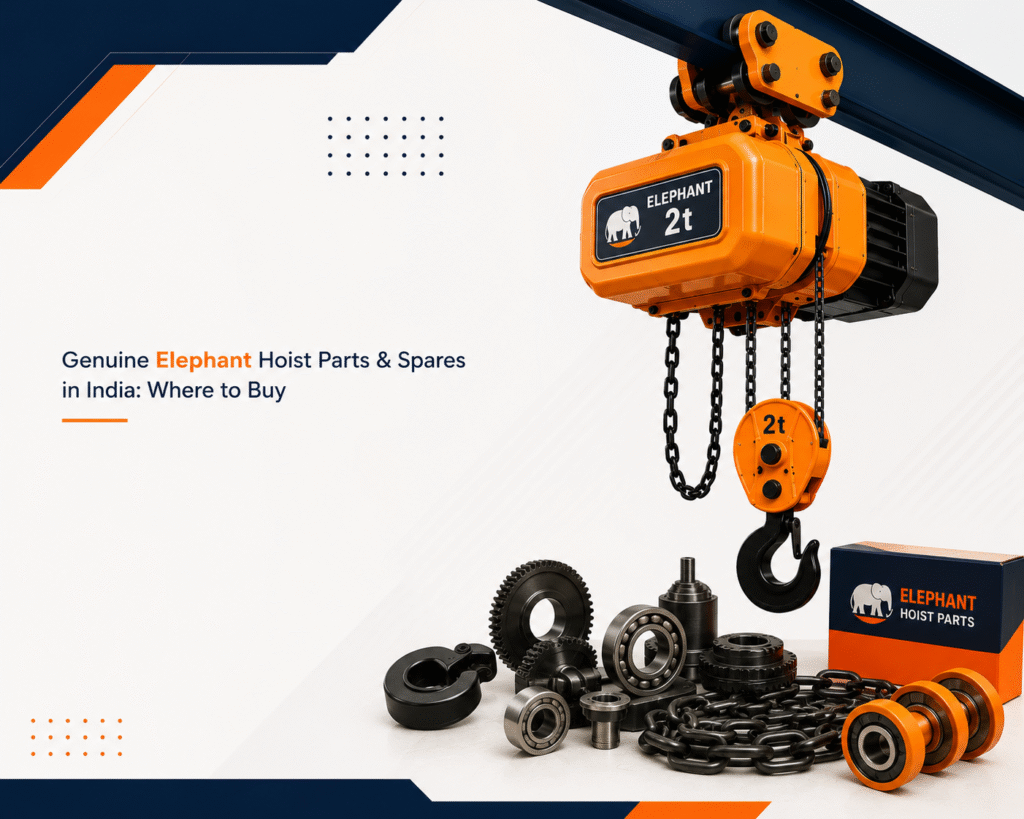
If your elephant chain hoist is losing speed, slipping under load or making a new noise, the solution is usually the same: the right spare part, bought from the right place. Elephant hoists are manufactured in Japan and are used in Indian factories, workshops and construction sites for steady load control and long service life. But even the strongest hoists sag over time, and that is where the hunt for real Elephant hoist parts & spares in India typically begins. This guide takes you through the common parts that fail, how to distinguish a genuine spare from a copy, what Indian law says about hoist maintenance, and where to buy parts that you can actually rely on. Why Genuine Elephant Hoist Parts Matter A hoist is not a single piece. It is a set of parts that work together under load. Chain, gears, brake, hook, and motor (on electric models). … Replace with a part that does not fit the original tolerance, and the strain moves to the parts around it. This mismatch has a tendency to wear out the entire assembly faster than a normal service cycle would. A part that does not fit within the correct tolerance puts extra stress on neighbouring components, causing them to wear out faster than their service intervals assume. Here’s why this is more important with lifting gear than most other machinery. A worn conveyor bearing slows production. Another type of risk is a worn part on a hoist holding a load over a work floor. Cranes and hoists that are not properly maintained may have corrosion or wear that breaks or damages parts, which can fall on people and equipment below. One reason that regulators keep a close watch on the inspection and repair of lifting equipment. The other piece is cost. Fake or mismatched parts often look great on the shelf. Fake parts are often sold as genuine because they can be packaged to look just like the real thing, and the real damage is only seen once the part is working under load. By then you are often paying for a breakdown, a production stoppage, and the right part, not just the right part. Common Elephant Hoist Parts That Wear Out First A short list of components accounts for the majority of service calls on a chain hoist. The parts most likely to be needed during the working life of an elephant hoist are: Load chain: elongation, rust, or link damage caused by overload or poor storage Hooks and hook latches: bend or crack with repeated use for heavy lifts Brake linings and friction discs: wear down, load slip or drift Gears and pawls: chip or round off with age, especially on lever hoists. Hand chain (for manual hoists) – stretches or kinks with heavy daily use Motor brushes, contactors and limit switches (on electric hoists): deterioration from duty cycle and heat Trolley wheels and bearings: flatten or seize from constant travel on the beam If any of these show signs of wear, replacing them with the exact original part keeps the rest of the hoist working as it was designed to. How to Spot Genuine Elephant Hoist Spares Just before you order, a quick checklist helps: Check the part number against your hoist model and series. Elephant parts are series-specific (C21, H100, YA, Y2, Alpha, Beta, etc.), and a part from one series never fits another series correctly. Ask for the source of supply. If a supplier can tell you exactly where the part comes from, that’s a good sign. A price that’s way below market value should be a red flag to stop and think about. Look at the finish and markings. The real chain, hooks, and gears are consistently stamped and finished. Copy has rough edges or missing markings. Request documentation. Ask for a certificate or supply invoice showing the part is linked to the manufacturer. Buy from an authorised dealer, not an unverified online listing with no address to trace the business. Legal and Safety Rules Around Hoist Maintenance in India India’s factory safety law does not take hoist maintenance for granted. As per the Factories Act, 1948, hoists and lifts in a factory are to be examined at intervals by a competent person, and the results are entered in a maintenance register. Section 27 is the requirement of periodic inspection of hoists and lifts, and Section 28 is the requirement of periodic inspection of lifting machines, chains, ropes and lifting tackled by a competent person. The Act also says that all lifting machines, chains and tackles shall be kept in good order and thoroughly examined by a qualified inspector, and the record thereof kept, and that every part of a lifting machine, chain, rope or tackle shall be of good construction and free from defects and shall be examined by a competent person at least once in every twelve months, and the results shall be entered in a register. That’s just another reason to stay with real parts.” A hoist with mismatched or unverified components can fail inspection, and that jeopardises your compliance and your workforce all at the same time. Where to Buy Genuine Elephant Hoist Parts & Spares in India Kolkata-based M.A. Zavery & Co. has been supplying elephant hoists and spares to industries all over India since 1983. The company stocks the Elephant range of manual hoists, including the C21 Series and H100 Series chain blocks and the YA, Y2 and Y3 Series lever hoists for angled or horizontal pulls. On the electric side, M.A.Zavery offers the Alpha, Beta, SA, FA/FB and DA/DB series of single-phase and three-phase elephant hoists and the plain, geared and electric trolleys that go with them. Traceability is the most important thing for anyone in India looking for genuine Elephant hoist parts and spares. M.A.Zavery sources its elephant stock through authorised channels and supports it with technical guidance in an effort to help you match the right part number, series and capacity to your existing hoist.
Top 10 Brands material handling equipment manufacturers In India
If you own a factory floor, a warehouse, or a workshop, there is one thing you already know. The right hoist, sling, or lifting clamp can save a shift. The wrong one can cost you far more than money. This is why it is important to choose from the proven material handling equipment manufacturer brands in India. This guide lists 10 brands Indian industries trust for hoists, chain blocks, wire ropes and rigging gear. We’ll also cover how to choose the right one for your setup and where to get hold of genuine stock. Why the Brand Behind Your Lifting Gear Matters Material handling equipment is no place to cut corners. A chain hoist or wire rope sling carries a real load, often over people and equipment. This is why the name of the brand on the tag matters: Load ratings remain. Good manufacturers test their gear to working load limits, not marketing claims. Replacement parts are easy to come by. When you know the brand, you can get a replacement chain or brake pad within months instead of waiting. There is safety documentation. When audits and insurance checks come around, test certificates and compliance records matter. Field support is on hand. Trained dealers are trained by established manufacturers to troubleshoot on-site. According to IMARC Group’s report, the India material handling equipment market reached US$ 10.57 billion in 2024 and is expected to reach US$ 22.48 billion by 2033, growing at a CAGR of 8.08% during 2024-2033. (IMARC Group, “India Material Handling Equipment Market Size, Share, 2034″, 2025, https://www.imarcgroup.com/india-material-handling-equipment-market) Much of this growth is fuelled by government-backed infrastructure spending and manufacturing incentives – which means more plants than ever are buying hoists, cranes and rigging equipment. Top 10 Material Handling Equipment Manufacturer Brands in India 1. Elephant You will often find elephant chain hoists and lever hoists on Indian shop floors. The range includes manual chain blocks, lever hoists and geared trolleys, along with single-phase and three-phase electric chain hoists for jobs that require faster, repeatable lifts. Elephant gear is good for maintenance bays, small fabrication units and general workshop lifting where reliable manual tools still get the job done. 2. STAHL STAHL is a German name with a long tradition in electric wire rope hoists and chain hoists for continuous industrial duty. STAHL is frequently selected for plants operating multi-shift, handling steel or heavy fabrication where uptime is critical. The hoists are intended for heavy-duty lifting cycles, not for occasional lifting. 3. Yale Yale is one of the oldest names in hoisting equipment, with a heritage in manual and powered chain blocks. Yale hoists are all over India in any workshop that needs a rugged, no-nonsense manual lifting tool that will keep on working through years of daily use. The brand’s lever hoists are also popular for pipeline and structural steel work. 4. Tiger Tiger Lifting manufactures manual and powered chain hoists for easy maintenance. Fabrication shops and rental fleets like Tiger Gear because parts are easy to replace and the hoists can handle rough site conditions. This is a brand to consider if your team works outdoors or on construction sites. 5. Yoke Taiwan’s Yoke is a manufacturer of lever hoists, chain blocks and rigging hardware for general industry and construction. The brand has built itself on consistent build quality at a price point that works for growing fabrication and engineering businesses. 6. Bridon Bekaert Bridon Bekaert provides steel wire ropes for cranes, hoists, elevators, and heavy rigging applications. The quality of your wire rope determines everything downstream, from load safety to how often you need to replace gear. Plants that run cranes or wire rope hoists require a wire rope brand that has a track record, and Bridon Bekaert is one of the names that comes up in that conversation. 7. Safelift Safelift is an industry leader in rigging accessories, including shackles, eye bolts, and lifting points – the small hardware that connects a load to a hoist or crane hook. Because these parts are subjected to repeated stress cycles, manufacturing tolerances need to be consistent. Where rigging accuracy is a must, Safelift gear is a popular choice. 8. Thiele Thiele specialises in chain slings, lashing chains and load securing components for transport and heavy lifting. Thiele products are used not only by lift companies but also by logistics operations, container yards and steel transport businesses to secure loads during movement. 9. Maxpull Maxpull manufactures winches and pulling equipment for cable laying, structural erection and general mechanical pulling jobs. If your work is dragging or tensioning loads rather than just straight vertical lifting, this is where a Maxpull winch earns its keep. 10. Ludwig Ludwig specialises in clamping systems for moving steel plates and sheets safely, such as plate lifting clamps and vertical or horizontal clamps. Ludwig clamps are used in steel stockyards, fabrication shops, and sheet metal facilities to transfer flat stock without the guesswork of improvised lifting methods. How to Choose the Right Brand for Your Operation Picking a brand isn’t just about the name on the box. Before ordering, please take the following steps: Match the load, not the brand. Compare the working load limit to your actual heaviest lift, with some margin. Check duty cycle. A hoist that is used a few times a day has different requirements than one that is continuously running on a production line. Validate environment. Equipment rated for the condition is required for outdoor locations, corrosive atmospheres, or spark-sensitive locations. Ask if they are certified. Test certificates and traceable documentation shall be available for each lifting component. Plan for spares. Choose a brand that your local dealer carries, and you won’t be waiting on a worn part on the sidelines for weeks. Where to Source These Brands in India Having genuine stock and the correct load documentation is as important as the brand you choose. M.A.Zavery & Co. has been supplying engineering products since 1983 and is an authorized Indian dealer of several of the brands covered